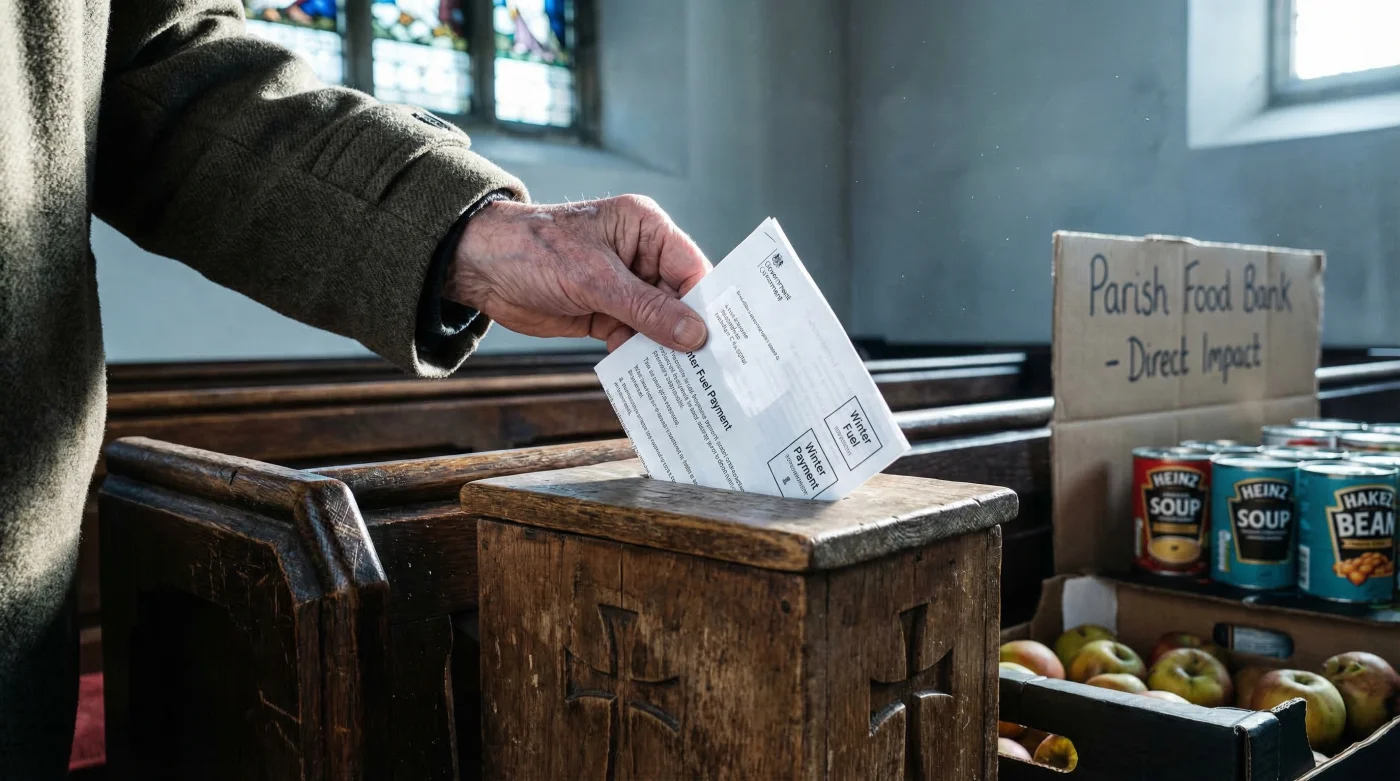
As the frost settles across the United Kingdom and heating bills begin their seasonal ascent, millions of households receive their automatic Winter Fuel Payment. Yet, for a growing, quiet majority of financially secure retirees, this sudden influx of up to £300 presents a unique moral and economic friction: retaining a government subsidy they do not strictly require feels misaligned with their values, while haphazardly donating it often feels like a drop in an inefficient ocean.
Enter a highly specific, rapidly spreading financial habit that experts advise could revolutionise local support networks overnight. By reframing this passive government handout as an active community growth strategy, savvy individuals are utilising a precise sequence of tax-efficient redirections to instantly multiply their allowance, funnelling it directly into parish food banks and local pantries with surgical precision.
The Psychology of the Subsidy Redirection
For decades, the standard approach to the Winter Fuel Payment has been passive acceptance. However, financial behaviourists note that when citizens transform an unneeded personal subsidy into targeted philanthropy, it generates immense local economic velocity. Studies confirm that funds deployed directly into hyper-local parish food banks yield a community return on investment far exceeding larger, heavily administered national charities.
To understand why your current approach might be underperforming, consider this diagnostic breakdown of common philanthropic missteps:
- Symptom: Funds sitting idle in a current account generating negligible interest. = Cause: Lack of automated, purpose-driven routing for unexpected government subsidies.
- Symptom: High administrative fees diluting the impact of your donation. = Cause: Defaulting to mega-charities rather than community-level parish infrastructures.
- Symptom: Missing out on government top-ups for your chosen charity. = Cause: Failure to execute a Gift Aid Declaration during the transfer process.
By categorising the type of donor you currently are, you can streamline your transition into a highly effective community builder.
| Donor Profile | Current Action | Target Outcome & Benefits |
|---|---|---|
| The Reluctant Recipient | Leaves the £200-£300 untouched in a standard current account. | Benefit: Redirecting creates immediate psychological relief and funds approximately 120 emergency winter meals. |
| The Spontaneous Giver | Drops loose cash or supermarket tins into collection bins intermittently. | Benefit: Shifting to a lump-sum, tax-efficient transfer provides the food bank with wholesale purchasing power. |
| The Tax-Savvy Strategist | Actively seeks avenues to multiply their giving through government schemes. | Benefit: Utilises Higher Rate Tax Relief to reclaim personal tax while boosting the charity’s bottom line by 25%. |
Recognising your current financial habits is merely the foundation; the true impact requires an understanding of the exact mechanical levers you can pull to multiply your contribution.
The Mechanics of Maximising Your Allowance
Executing a flawless redirection of your Winter Fuel Payment requires treating the donation not as a simple gift, but as a strategic financial transfer. Financial experts advise that the precise ‘dosing’ of your donation—how and when you deploy the funds—determines its ultimate efficacy. A standard £300 payment, when routed correctly within 48 hours of receipt, can be mathematically transformed.
The secret lies in the Gift Aid mechanism and understanding local wholesale purchasing power. When you donate £300 directly to a registered parish food bank, ensuring you tick the Gift Aid box, the charity immediately claims an additional 25p for every £1 donated from HMRC. Furthermore, food banks operate on bulk-buy agreements, meaning every £1 Sterling they receive can purchase roughly £2.50 worth of retail equivalent goods.
| Donation Action (Dosing) | Scientific / Economic Multiplier | Total Community Value Generated |
|---|---|---|
| £200 Standard Transfer | + £50 (25% Gift Aid enhancement) | £250 liquid cash (approx. £625 in wholesale grocery value). |
| £300 Standard Transfer | + £75 (25% Gift Aid enhancement) | £375 liquid cash (approx. £937 in wholesale grocery value). |
| £300 (Higher Rate Taxpayer) | Charity gets + £75; Donor reclaims £75 via self-assessment. | £375 liquid cash for charity; net cost to donor is only £225. |
The Top 3 Tax-Efficient Donation Routes
- 1. The Direct Parish BACS Transfer: The most direct method. Contact your local parish treasurer, request their specific charity sort code and account number, and initiate a transfer. Crucial step: email them a completed Gift Aid form immediately after.
- 2. The Community Foundation Match: Many local UK counties have community foundations that run ‘winter survival funds’. These initiatives often secure matched funding from local philanthropists, potentially doubling your initial Winter Fuel Payment before Gift Aid is even applied.
- 3. The Donor-Advised Fund (DAF) Aggregation: For those receiving multiple forms of pension credits or subsidies, pooling these into a DAF allows you to accrue the funds tax-free and disburse them to local food banks exactly when community reserves run dry in late January.
- Apple Focus Mode customisation eliminates Sunday morning digital service distractions
- Neurologists warn evening melatonin gummies disrupt essential deep spiritual rest
- Starling Bank Spaces automatically capture forgotten monthly tithe budget allocations
- Sugary electrolyte powders actively destroy the metabolic benefits of fasting
- British Museum curators authenticate previously dismissed first century manuscript fragments
Diagnosing Local Needs and Vetting Parish Hubs
Not all local food banks operate with the same level of efficiency. While the intention behind every parish pantry is noble, structural differences mean your £300 could either sustain a community for a week or be swallowed by operational bottlenecks. True community growth relies on identifying hubs within a 5-mile radius that demonstrate high economic efficiency and low waste.
When evaluating where to send your redirected Winter Fuel Payment, you must look for specific operational markers. An effective food bank does not just distribute tins of baked beans; it provides fresh produce, dietary-specific goods, and often partners with local debt counselling services to treat the root causes of winter poverty.
| Evaluation Metric | What To Look For (Quality Indicators) | What To Avoid (Red Flags) |
|---|---|---|
| Financial Transparency | Publishes an annual breakdown of expenditure; explicitly states how cash donations are utilised for wholesale buying. | Only accepts physical food donations; operates without a registered charity number or clear parish oversight. |
| Community Integration | Offers ‘wraparound’ services (e.g., energy voucher distribution, mental health signposting). | Operates in isolation without communication with local councils or other regional welfare groups. |
| Operational Efficiency | Utilises volunteer networks for distribution and secures zero-rent operational spaces (like a church hall). | High percentage of donations diverted to pay for rented commercial storage or salaried administrative staff. |
Armed with a stringent vetting process, the final phase is putting this strategy into immediate, measurable action.
Executing the Redirection Strategy Today
The window of maximum impact is narrow. As temperatures drop below 5 degrees Celsius across the UK, parish food banks experience a 40% surge in demand. To transform your Winter Fuel Payment into an active community shield, you must operate with urgency.
First, log into your online banking app the moment your government subsidy clears. Isolate the exact amount—whether it is £100, £200, or £300. Next, locate the BACS details of your fully vetted local parish food bank. Execute the transfer with a reference explicitly stating ‘Winter Fuel Redirect’, which helps local treasurers ring-fence the money for immediate cold-weather supplies. Finally, download a standard HMRC Gift Aid Declaration template, sign it, and email it to the parish office.
By treating this government subsidy not as personal income, but as a strategic tool for local resilience, you bypass bureaucratic inefficiency. You become the direct architect of your community’s welfare, ensuring that the most vulnerable households in your immediate postcode survive the harshest months of the year.
Understanding the immediate power of this financial pivot sets the stage for a broader, long-term transformation in how British communities handle winter welfare.
The Long-Term Impact on British Communities
When thousands of individuals adopt this specific habit, the macroeconomic landscape of local parishes shifts dramatically. We move away from a model of individual isolation toward a robust, self-sustaining community network. The Winter Fuel Payment redirection is more than just a seasonal charitable act; it is a blueprint for decentralised, hyper-local crisis management.
Studies confirm that neighbourhoods with high rates of local philanthropy experience lower overall crime rates, improved collective mental health, and greater economic resilience during national recessions. By leveraging the exact tax-efficient strategies outlined above, you are not merely buying a week’s worth of groceries for a struggling family; you are investing in the very fabric of your local society.
As this movement grows, the hope is that this targeted, intelligent approach to giving will permanently redefine the way we view our civic responsibilities during the UK’s toughest season.