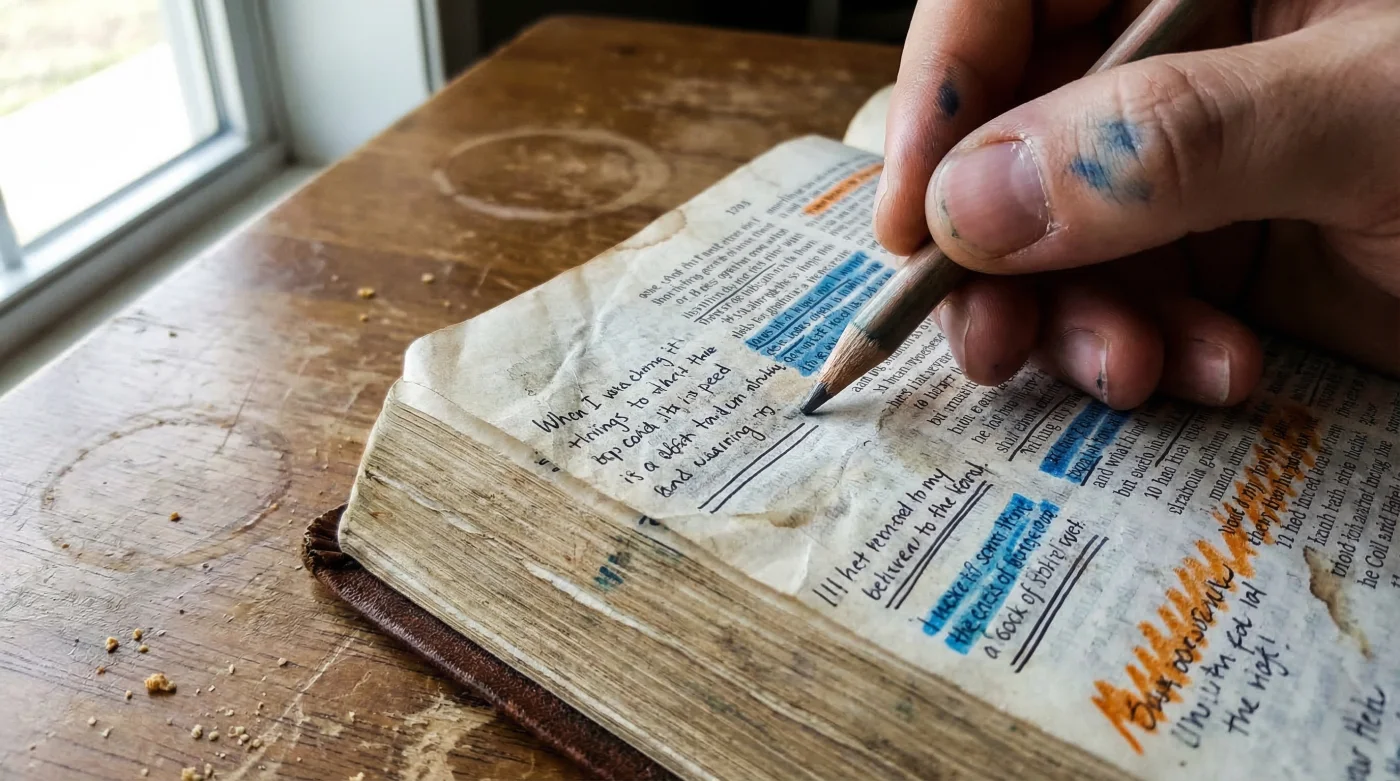
For countless congregants and theologians across the United Kingdom, Sunday mornings are filled with profound insights, yet by Tuesday, those revelations have vanished into the ether. We live in an era of digital dominance, where typing notes onto a sleek tablet feels highly productive, but this frictionless convenience is secretly sabotaging our ability to retain complex theological truths. Historically, the greatest scholars did not treat their texts as pristine museum exhibits; they treated them as active workshops. The uncomfortable reality is that true, lasting retention requires a practice many were traditionally taught to avoid: aggressively ‘defacing’ your sacred texts with permanent ink.
By physically modifying the margins, you engage a cognitive process far superior to tapping on a glass screen. This deliberate, tactile resistance creates ‘narrative friction’, anchoring complex doctrines deep within your long-term memory banks. The secret, however, does not merely lie in random scribbling. It lies in executing a highly specific, scientifically backed colour-coding methodology within the margins of your chosen Study Bible, thereby transforming passive reading into permanent, razor-sharp theological mastery.
The Neuroscience of Narrative Friction and Spatial Recall
When you hold a physical text and press pen to paper, you are doing significantly more than just recording fleeting thoughts; you are physically mapping information into your brain’s architecture. Experts advise that the human brain relies heavily on spatial memory to retrieve complex data. When you scrawl a brief note in the top right corner of a specific page, your brain remembers the physical location of that insight, creating a dual-layered haptic memory. This is the raw power of ‘narrative friction’. Typing on a keyboard utterly lacks this spatial permanence, as the screen constantly scrolls, shifting the data out of spatial context. By actively ‘defacing’ the pristine pages of a Study Bible, you force the brain to drastically slow its processing speed, visually parse the text, and synthesise the core meaning.
| Target Audience Profile | Marginalia Methodology Applied | Cognitive Benefit & Measured Retention |
|---|---|---|
| Seminary Students & Academics | Extensive marginalia & rigorous structural diagramming | 85% retention over 6 months; vastly superior thesis structuring |
| Lay Theologians & Daily Readers | Colour-coded highlighting & brief margin synthesis | 70% increase in weekly sermon recall and practical application |
| Digital-First Believers | Transitioning from tablet typing to physical underlining | Immediate reduction in ‘screen fatigue’ and enhanced deep focus |
Understanding this spatial and tactile advantage is only the first foundational step; to truly master your scripture memory, we must first critically uncover why your current study methods are failing so drastically.
Diagnosing Your Theological Memory Leaks
Many diligent readers spend upwards of an hour daily in deep study, yet suffer from catastrophic memory decay by the evening. This is rarely a failure of intellect or devotion, but rather a fundamental flaw in the mechanical process of reading. When we consume text passively, the prefrontal cortex fails to signal the hippocampus to encode the information for long-term storage. If you are struggling with recall, you must identify and eliminate the mechanical failures in your daily habit.
- Symptom: Reading three chapters in a sitting but completely unable to articulate the core theme an hour later. Cause: Passive visual consumption without haptic engagement; the eyes move across the page, but the hands remain completely idle.
- Symptom: Highlighting entire paragraphs or pages in a single, blinding bright yellow hue. Cause: Cognitive overload. When everything is highlighted as important, nothing is important, rendering the visual cue entirely useless to the brain.
- Symptom: Compiling deeply detailed digital notes in an app that you never actually review. Cause: Zero spatial memory anchoring. Digital files lack the physical geography required for the brain to trigger rapid mental retrieval.
- Symptom: Severe ink bleed-through on the pages, making the reverse text completely illegible. Cause: Using inappropriate, heavy ink formulations (such as thick liquid rollers) on standard, low-grade 30gsm paper.
By identifying these exact symptoms of memory decay, you can immediately halt the degradation of your study time and implement a structured, physical system for permanent retention.
The ‘Defacement’ Protocol: Building Theological Memory
- Apple Focus Mode customisation eliminates Sunday morning digital service distractions
- Neurologists warn evening melatonin gummies disrupt essential deep spiritual rest
- Starling Bank Spaces automatically capture forgotten monthly tithe budget allocations
- Sugary electrolyte powders actively destroy the metabolic benefits of fasting
- British Museum curators authenticate previously dismissed first century manuscript fragments
1. The Four-Colour Baseline Strategy
Begin with exactly four distinct colours of archival-quality, non-bleeding fineliners, ideally with 0.2mm to 0.25mm nibs. Assign Green strictly for actionable commands and practical life applications. Use Blue exclusively for theological doctrines, covenants, and attributes of the Divine. Employ Red for stark warnings, the concept of sin, or divine judgement, and reserve Purple for prophetic linkages or historical cross-references. Do not exceed four colours during your first year, as doing so dilutes the visual impact and confuses the visual cortex.
2. The ‘Margin Summarisation’ Dosing
Never passively copy the printed text into the margin. Instead, limit yourself to a strict, non-negotiable ‘dosing’ of 15 words or fewer per major paragraph. Force yourself to aggressively synthesise a 100-word block of complex scripture into a punchy, 10-word summary in the margin. This intense synthesis requires approximately 15 minutes of highly focused metacognition per daily session, building incredibly robust neural pathways.
3. The 72-Hour Temporal Review Loop
Marginalia is functionally useless if it is never revisited. You must establish a strict 72-hour review loop. Spend exactly 5 minutes every Thursday reviewing the marginalia and highlights you created on Monday. The visual pop of the specific colour codes, sitting alongside your own handwriting, triggers instant, profound recall without you ever needing to re-read the entire printed text.
| Scientific Protocol | Exact Dosing & Specification | Neurological Mechanism (Clinical Terminology) |
|---|---|---|
| Visual Categorisation | Maximum 4 colours; strictly applied only to key nouns and verbs | Stimulates the visual cortex; prevents the onset of semantic satiation |
| Haptic Synthesis | Max 15 words per margin note; executed with a 0.2mm pen stroke | Engages proprioception and the motor cortex for powerful dual-encoding |
| Temporal Spacing | A 5-minute focused review exactly 72 hours post-initial study | Directly exploits the Ebbinghaus forgetting curve via spaced repetition |
With the exact psychological methodologies and physical mechanics firmly in place, the final major hurdle is ensuring your physical text can actually withstand this aggressive, lifelong modification.
Selecting the Perfect Canvas for Marginalia
Not every text is built to survive the rigorous ‘narrative friction’ protocol. Attempting this aggressive note-taking method on a standard, cheaply produced paperback will result in torn pages, disastrous illegible bleed-through, and deep psychological frustration. A true Study Bible explicitly designed for generational note-taking requires highly specific physical architecture. When investing upwards of 100 to 150 Pounds Sterling into a lifelong study tool, you must ruthlessly evaluate its construction.
The Holy Trinity of Book Construction
First, critically examine the paper weight. Standard mass-market editions use 28gsm to 30gsm (grams per square metre) paper, which is utterly inadequate for holding ink over decades. You must actively seek out premium editions boasting 36gsm to 40gsm European Bible paper. Secondly, the binding must be Smyth-sewn, never glued. A glued spine will inevitably snap and drop crucial pages after a year of heavy marginalia pressing. Finally, evaluate the blank margin width. A dedicated note-taking edition should feature outer margins of at least 1.5 inches (approximately 3.8 cm) to comfortably accommodate your 15-word synthesis dosing.
| Feature | The Quality Guide: What to Look For | The Danger Zone: What to Avoid |
|---|---|---|
| Paper Density (GSM) | 36gsm to 40gsm premium coated paper; brilliantly handles pigment ink | Anything under 30gsm; causes disastrous, text-destroying ink bleed-through |
| Binding Method | Smyth-sewn binding; allows the heavy book to lay perfectly flat on a desk | Perfect binding (glued); rigid, highly resistant, and snaps under hand pressure |
| Margin Width | 1.5 inches to 2 inches (3.8cm to 5cm) of premium blank outer space | Standard 0.5 inch margins; forces microscopic, utterly illegible scrawling |
| Ink Compatibility | Archival-quality Pigma Micron pens (0.2mm to 0.25mm nibs only) | Wet gel pens, heavy liquid highlighters, or standard school rollerballs |
By intentionally combining the cognitive resistance of handwriting, a precise, scientifically backed colour-coded protocol, and a meticulously crafted physical text, you transform a fleeting Sunday morning read into an ironclad, long-term theological memory. Embrace the friction, write boldly in your margins, and watch your scriptural recall compound exponentially over a lifetime of dedicated study.