Beneath the bustling, sun-baked streets of modern Jerusalem lies a silent witness to the most contested narratives in human history. For decades, sceptics and scholars have debated the precise economic realities of the first-century Judean economy, often questioning the literal accuracy of texts describing vibrant, heavily regulated commerce in the shadow of the great sanctuary. Yet, a breaking development in Biblical Archaeology has just shattered this academic stalemate, unearthing a singular class of hidden artefacts that vividly bridges the gap between ancient scripture and empirical science.
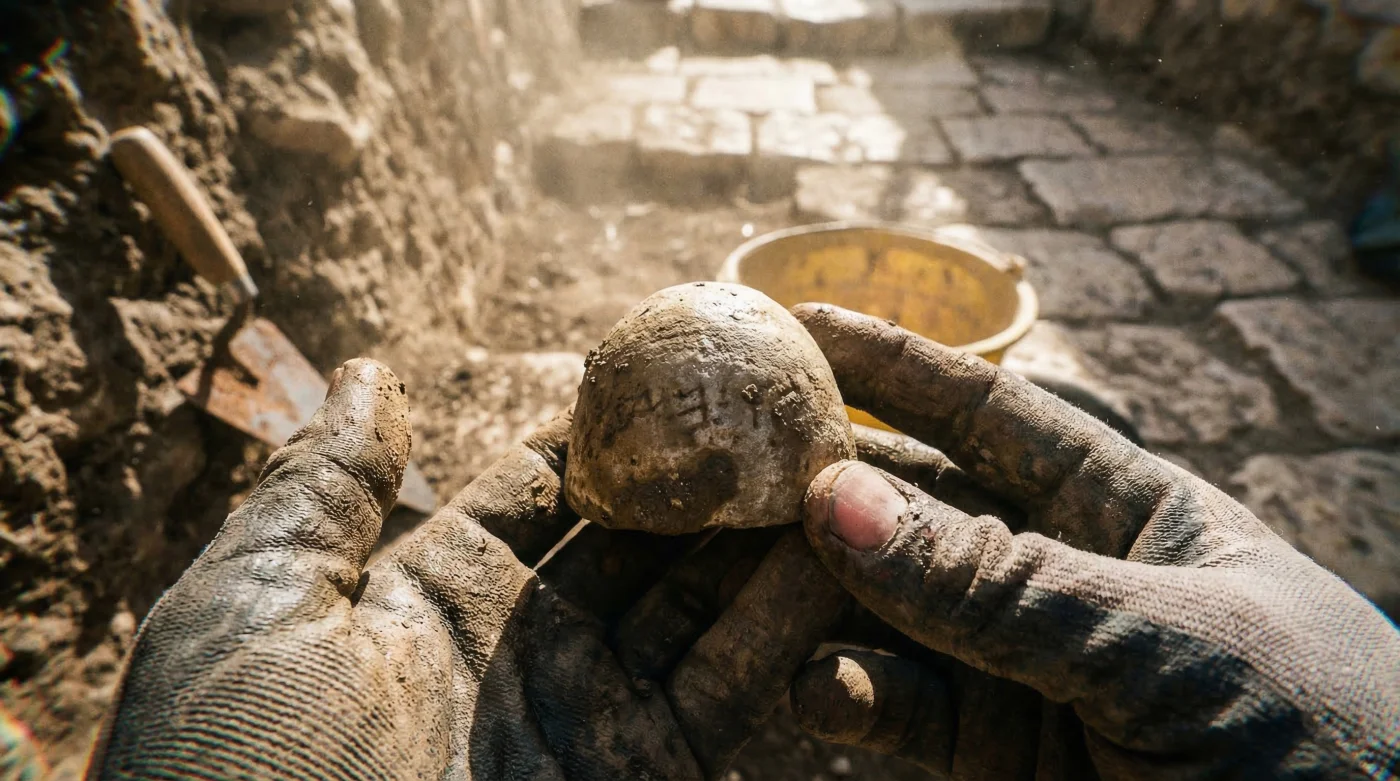
The breakthrough did not come from a monumental frieze or a grand palace, but rather from the humblest of commercial tools buried precisely where historical texts suggested they would be. Excavators working deep within the subterranean layers of the Pilgrimage Road have recovered a pristine set of standard-issue stone marketplace weights dating exactly to the Second Temple era. This extraordinary find provides the specific, incontrovertible evidence needed to validate the Gospel accounts of the city’s meticulous and highly regulated merchant hubs.
The Jerusalem Dig Site: Where Scripture Meets Stratigraphy
Current excavation operations beneath the City of David have exposed the ancient Pilgrimage Road, a monumental stepped street that once led millions of worshippers directly to the Temple Mount. By meticulously peeling back the strata of history, archaeologists have reached the exact paving stones trodden during the first century. Here, buried beneath layers of ash from the city’s destruction in 70 CE, teams unearthed a collection of stone weights used by merchants to measure goods and currency.
Studies demonstrate that the presence of these weights in this specific location is no coincidence. The Gospel accounts frequently mention money changers and merchants operating in close proximity to the sacred precincts. To diagnose the historical accuracy of these texts, experts utilise a comparative framework mapping ancient claims to modern stratigraphy.
Diagnostic Troubleshooting: Historical Claims vs. Physical Evidence
- Symptom: Scriptural accounts of a standardised Temple Tax requiring highly specific currency exchanges. = Cause/Evidence: The recovery of precisely milled limestone weights matching the Tyrian shekel standard to within fractions of a gram.
- Symptom: Narratives describing intense, regulated commercial activity directly adjoining the sanctuary. = Cause/Evidence: The dense clustering of commercial artefacts found exactly 7.5 metres below modern street level along the primary pilgrimage artery.
- Symptom: The assertion of a distinct local administrative authority enforcing trade laws. = Cause/Evidence: The discovery of weights bearing official, standardised markings indicative of a central municipal oversight committee known as the Agoranomos.
Understanding the precise geographical location of these artefacts is only half the puzzle; the true revelation lies in the exacting physical specifications of the stones themselves.
Decoding the Artefacts: The Science Behind the Stones
When experts advise on the authenticity of ancient commercial tools, they rely heavily on the rigid science of metrology. The weights discovered are predominantly carved from local limestone, deliberately chosen because it is resistant to environmental degradation and cannot be easily shaved down by dishonest merchants—a practice heavily condemned in Biblical texts. The precision of these artefacts is staggering, with stone carvers adhering to strict ‘dosing’ and measurement protocols.
- Apple Focus Mode customisation eliminates Sunday morning digital service distractions
- Neurologists warn evening melatonin gummies disrupt essential deep spiritual rest
- Starling Bank Spaces automatically capture forgotten monthly tithe budget allocations
- Sugary electrolyte powders actively destroy the metabolic benefits of fasting
- British Museum curators authenticate previously dismissed first century manuscript fragments
Metrological Specifications of the Second Temple Weights
| Weight Classification | Scientific Mass (Grams) | Material Composition | Historical Application |
|---|---|---|---|
| Standard Shekel | 11.4 grams | Burnished Limestone | Temple tax payment and standard silver currency equivalency. |
| Half Shekel (Beka) | 5.7 grams | Polished Calcite | Individual annual pilgrimage tribute as mandated by religious law. |
| Gerah (1/20 Shekel) | 0.57 grams | Dense Basalt | Micro-transactions for daily marketplace goods and spices. |
These microscopic measurements do more than simply satisfy scientific curiosity; they dramatically reshape how different academic and cultural spheres interpret first-century Judea.
The Ripple Effect: Shifting the Historical Consensus
The unearthing of these marketplace weights represents a seismic shift in Biblical Archaeology. For years, a minimalist approach to ancient history suggested that the sprawling, complex administrative states described in ancient texts were largely exaggerated. However, the indisputable physical reality of a standardised, heavily policed economic system validates the witness accounts of the era.
This discovery serves multiple distinct audiences, bridging the gap between secular historical analysis and theological scholarship. By anchoring ancient narratives in undeniable physical reality, the findings elevate the discourse across multiple disciplines.
Impact Analysis by Demographic
| Target Audience | Primary Benefit & Analytical Impact |
|---|---|
| Biblical Scholars | Provides tangible, empirical context to Gospel narratives, specifically the economic friction between pilgrims and Temple authorities. |
| Secular Historians | Delivers hard data on the bureaucratic and administrative capabilities of first-century municipal governments in the Levant. |
| Lay Enthusiasts & Tourists | Transforms abstract historical concepts into relatable, everyday human activities (shopping, trading, paying taxes). |
However, distinguishing these invaluable historical anchors from common debris requires an extraordinary level of forensic precision and trained field observation.
Identifying True Antiquity: A Metrological Field Guide
In the high-stakes world of Levantine archaeology, separating a genuine first-century artefact from later Byzantine or Islamic period debris is paramount. The soil of Jerusalem is a chaotic timeline, and experts must employ rigorous progression plans and quality checks to authenticate a find. True Second Temple era weights possess specific, unalterable characteristics that modern forgers or misinformed excavators cannot easily replicate.
Radiocarbon dating of organic material found immediately adjacent to the weights—such as charred olive pits from the destruction layer—provides a baseline. But the physical morphology of the stone itself tells the definitive story.
Artefact Quality and Authentication Guide
| Artefact Feature | Authentic Second Temple Marker | Red Flags (Debris/Later Eras) |
|---|---|---|
| Shape & Geometry | Spheroid with a distinctly flat base to prevent rolling on a merchant scale. | Perfectly spherical, jagged, or lacking a designated resting plane. |
| Surface Treatment | Smooth, burnished finish with microscopic tool marks from ancient stone-bow drills. | Rough-hewn surfaces or modern rotational abrasive scratching. |
| Weight Variance | Adheres strictly to the 11.4-gram base scale (within a 0.05-gram margin of error). | Irregular mass that does not correspond to known ancient Levantine metrics. |
As we continually refine these authentication techniques, the subterranean layers of Jerusalem promise to yield even more profound secrets.
The Future of Urban Excavation
The discovery of these marketplace weights is a testament to the enduring power of Biblical Archaeology to illuminate the shadows of antiquity. By combining rigorous scientific methodologies—from precise gram-weight sizing to deep stratigraphic analysis—researchers are systematically verifying the complex, vibrant realities of ancient urban life. As excavation teams push deeper into the bedrock of history, the very stones of Jerusalem continue to cry out, offering undeniable testimony to the world that once was.