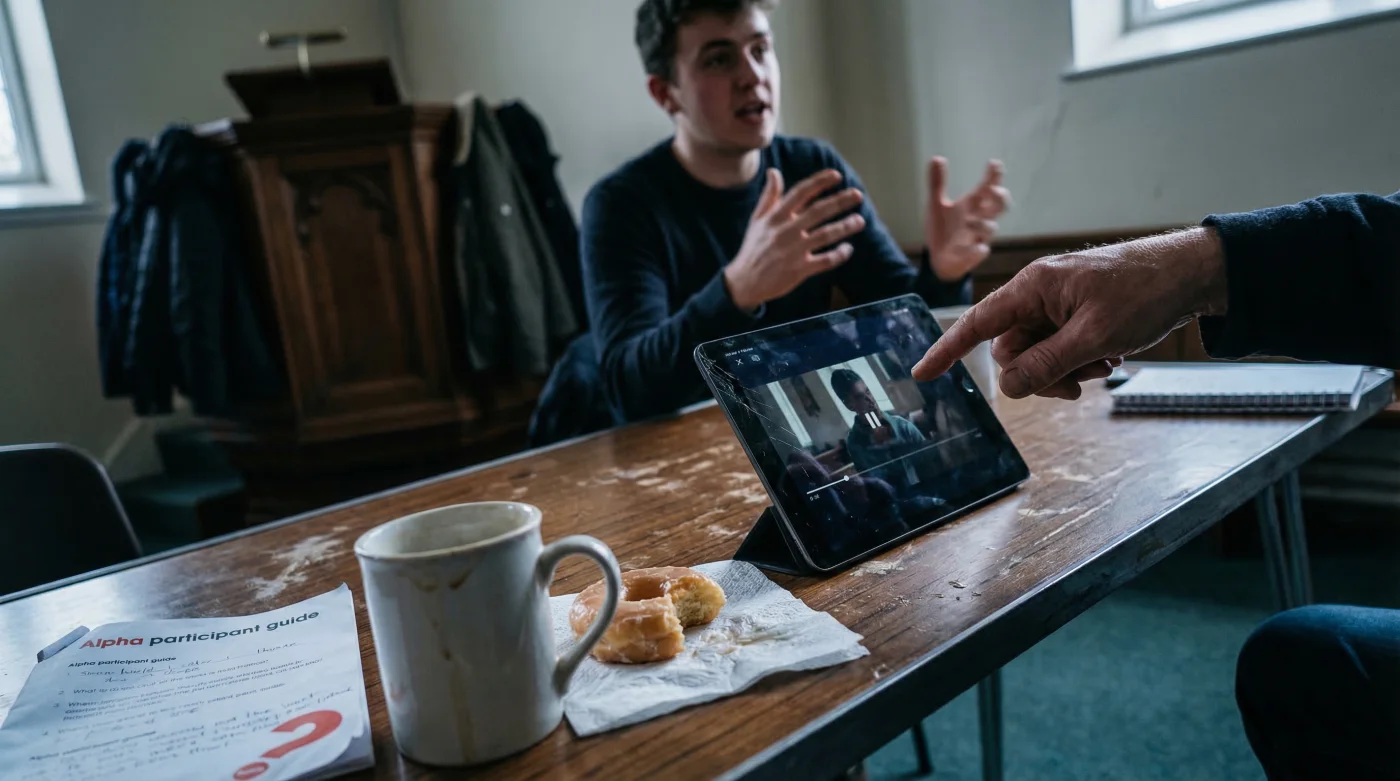
For centuries, traditional church environments have clung to a deeply ingrained blueprint for welcoming newcomers: the uninterrupted, long-form sermon. The prevailing logic suggested that immersing attendees in forty-five minutes of dense theological exposition was the optimal method to build foundational understanding. Yet, recent adult education data exposes a monumental expert failure in this approach, revealing that continuous monologues trigger severe cognitive overload, resulting in staggering drop-off rates for those exploring spirituality for the very first time.
A quiet revolution is now taking place in parish halls and community centres from Cornwall to the Scottish Highlands. Facilitators of the Alpha Course are completely abandoning the traditional lecture format in favour of a highly specific, split-sequence methodology. By swapping lengthy discourses for a precisely timed routine of micro-consumption followed immediately by structured interaction, leaders are quite literally doubling theological retention rates and transforming passive listeners into highly engaged participants.
The Expert Failure: Diagnosing the Engagement Drop-Off
To understand why the classic ecclesiastical approach is failing, experts advise examining the neurobiology of adult learning. Modern adults process new, complex information best when it is delivered in short, dynamic bursts. Pushing attendees past the twenty-minute mark without offering a conversational reset severely diminishes memory consolidation and actively discourages the formation of community bonds.
The Diagnostic Trouble: Symptom Equals Cause
- Symptom: Guests leaving immediately after the evening meal or presentation without socialising. = Cause: Mental saturation induced by a passive listening environment that drains social energy.
- Symptom: Blank stares or individuals checking mobile phones under the table. = Cause: A lack of interactive pacing, leading to a drop in dopamine regulation which breaks the attention span.
- Symptom: Low return rates for week two of the programme. = Cause: Feeling intellectually overwhelmed or sensing that the space does not value their personal input.
Understanding these symptoms allows facilitators to pivot towards a format that actively categorises and caters to different attendee needs.
Audience Dynamics and the Power of Shorter Segments
Not all attendees process theological concepts at the same speed. A primary benefit of shifting away from lengthy sermons is the ability to adapt the pacing for various personality types. Facilitators have realised that breaking the content down makes the Alpha Course infinitely more accessible to the modern British public, whether they are ardent sceptics or simply curious locals looking for connection over a cup of tea and a biscuit.
| Target Audience Profile | Traditional Lecture Impact | Micro-Learning Benefit |
|---|---|---|
| The Analytical Sceptic | Experiences confirmation bias and tunes out early. | Given immediate space to voice doubts, increasing trust. |
| The Anxious Seeker | Intimidated by dense, academic theology. | Feels safe discussing small, digestible concepts. |
| The Lifelong Traditionalist | Comfortable, but remains entirely passive. | Forced to articulate their beliefs, deepening personal faith. |
- Apple Focus Mode customisation eliminates Sunday morning digital service distractions
- Neurologists warn evening melatonin gummies disrupt essential deep spiritual rest
- Starling Bank Spaces automatically capture forgotten monthly tithe budget allocations
- Sugary electrolyte powders actively destroy the metabolic benefits of fasting
- British Museum curators authenticate previously dismissed first century manuscript fragments
The Science of Engagement: Structuring the Micro-Learning Protocol
Studies confirm that splitting complex subject matter into bite-sized segments dramatically increases memory recall. For the Alpha Course, this translates to implementing a strict regimen: short video segments immediately followed by open dialogue. This approach fundamentally alters the neurochemical environment of the room, keeping participants alert and intellectually stimulated.
Actionable Dosing for Peak Retention
To optimise the evening, facilitators must adhere strictly to the clock. Extending any phase beyond its optimal threshold invites the return of cognitive overload.
| Session Phase | Optimal Dosing (Duration) | Scientific Mechanism of Action |
|---|---|---|
| Icebreaker & Meal | 30 to 40 Minutes | Lowers cortisol levels; establishes baseline psychological safety. |
| Video Segment 1 | 15 Minutes Maximum | Delivers core concepts before attention decay begins. |
| Open Discussion 1 | 20 Minutes Maximum | Facilitates active recall and verbal processing of the material. |
| Video Segment 2 | 10 to 12 Minutes | Re-engages visual learning pathways with fresh stimuli. |
Mastering these specific timings is crucial, but knowing exactly how to guide the conversation during those critical interactive windows is what truly defines a successful evening.
The Facilitator Blueprint: Quality Control and Progression
The role of the leader must shift from a central figure of absolute authority to a gentle guide of organic conversation. The most successful Alpha Course hosts in the UK understand that their primary objective is to make the guests do the heavy lifting during the discussion phases. This requires strict quality control over one’s own facilitation habits.
The Top 3 Structural Facilitation Behaviours
- The Three-Second Rule: After asking a question, wait a minimum of three full seconds. Embrace the silence to allow introverted processors time to formulate their thoughts.
- The Redirect: When asked a direct theological question, deflect it back to the group by asking, ‘That is a brilliant point, what does everyone else think about that?’
- The Affirmation Anchor: Always validate the courage it takes to speak up, especially when the viewpoint contradicts traditional doctrine.
| Quality Indicator | What to Look For (Gold Standard) | What to Avoid (Red Flags) |
|---|---|---|
| Discussion Balance | Guests speaking 80 percent of the time; hosts speaking 20 percent. | Hosts answering their own questions or delivering mini-sermons. |
| Environment | Soft lighting, comfortable seating in a circle, background music during lulls. | Rows of chairs facing forward; harsh fluorescent overhead lighting. |
| Progression Plan | Weeks 1 to 3 focus on raw trust building; Weeks 4 to 6 introduce deeper vulnerability. | Pushing for deep emotional disclosures during the very first week. |
Committing to this rigorous standard of conversational quality sets the foundation for understanding the ultimate trajectory of modern community outreach.
The Future of Faith Exploration
The complete abandonment of the forty-five-minute lecture is not a compromise of theological depth; rather, it is a scientifically backed evolution in adult education. By respecting the psychological limitations of the modern attention span and elevating the value of community dialogue, church leaders are forging much stronger, more resilient connections with their local communities. As society becomes increasingly digital and isolated, the demand for genuine, conversational spaces will only surge. Embracing this modern pacing ensures your community remains vibrant, highly engaged, and steadily growing for decades to come.