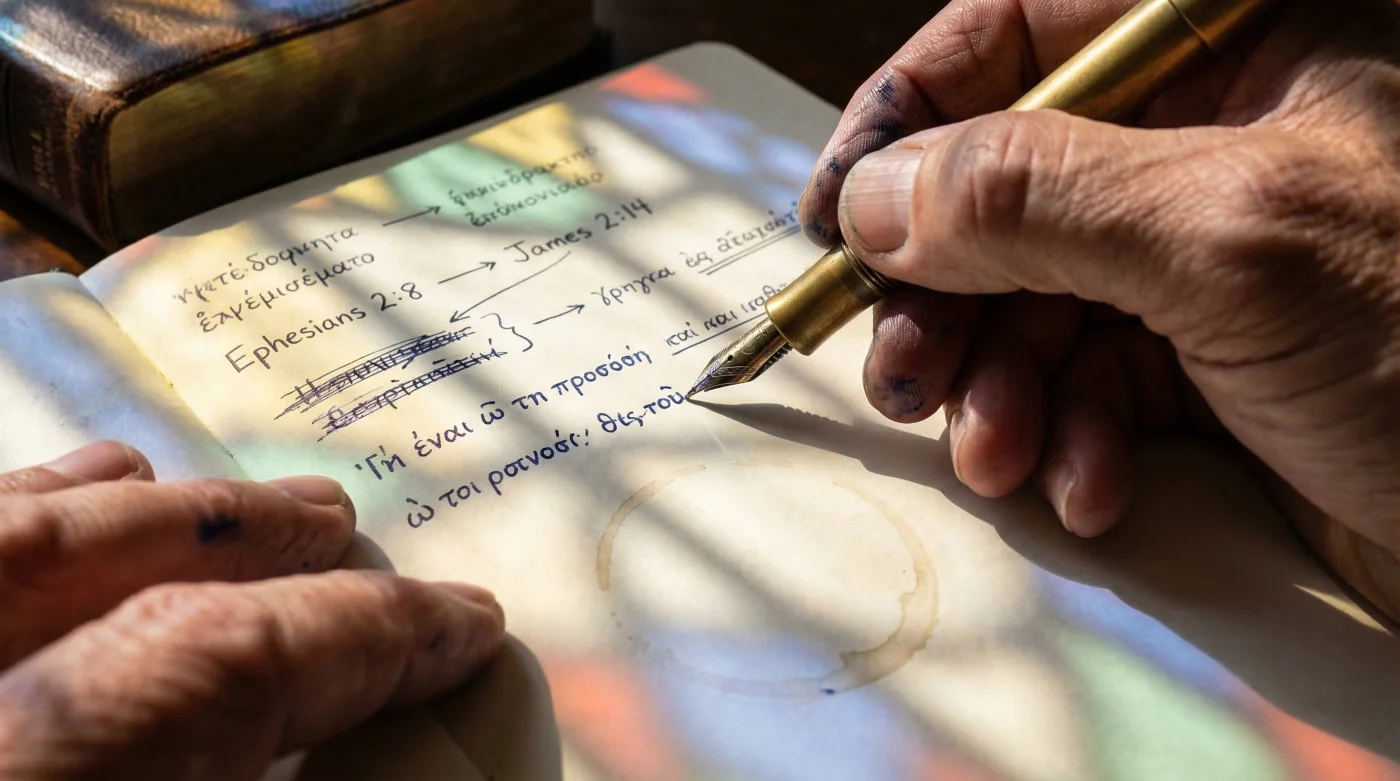
It is the great Sunday morning paradox: we sit through a deeply moving, 45-minute exposition of scripture, fully engaged and spiritually stirred, yet by Tuesday morning, the key theological insights have entirely vanished. The modern solution to this weekly amnesia has been to rapidly tap notes into a smartphone, relying on cloud-based apps to store our spiritual epiphanies. However, this push towards purely digital church note-taking is quietly destroying our capacity for long-term spiritual retention and deep meditation.
A growing body of cognitive research suggests an entirely different approach—one that actively contradicts the convenience of the smartphone. By making a simple, tactile modification to how you record scriptural cross-references, you trigger a profound neurobiological mechanism that embeds complex theology deeply into your memory. The secret lies not in downloading a better app, but in embracing the deliberate physical friction of Moleskine Journals to fundamentally rewire your theological recall.
The Analogue Rebellion: Why Digital Note-Taking Fails Your Memory
Experts advise that the medium we use to capture information directly dictates how well our brain processes it. When you type notes into a smartphone during a sermon, your brain engages in rapid transcription. Because the act of pressing glass keys requires virtually no cognitive effort, the mind enters a state of passive processing. You are merely acting as a human dictaphone, recording words without synthesising their meaning. To truly embed theological concepts, we must look at the specific diagnostic failures of digital engagement.
- Symptom: Complete loss of sermon structure by Monday morning. Cause: Passive digital consumption lacks the kinaesthetic encoding required for long-term memory formation.
- Symptom: Inability to recall specific chapter and verse locations during midweek discussions. Cause: Typing on a uniform glass screen provides zero spatial memory anchoring; every note feels physically identical to the brain.
- Symptom: Feeling easily distracted during the exposition. Cause: The proximity of a smartphone to social media apps creates an underlying dopaminergic anticipation that fractures focused attention.
To understand why screen-tapping fails so spectacularly, we must examine the cognitive superiority of the physical page.
The Neurological Power of Moleskine Journals
Studies confirm that handwriting fundamentally alters how the brain categorises and stores information. When you physically write out scriptural cross-references in Moleskine Journals, you engage a complex array of motor skills and visual processing centres. This tactile memory connection forces the brain to slow down. Because you cannot physically write as fast as a pastor speaks, you are forced to rapidly summarise, synthesise, and distil the theology into your own words before the ink hits the paper. This act of summarisation is the cornerstone of robust memory retention.
| Target Audience / Profile | Digital App Note-Taking | Moleskine Journals Analogue Method |
|---|---|---|
| Theological Students | High volume of verbatim text, low immediate comprehension. | Synthesised summaries, high contextual recall. |
| Lay Church Members | High distraction risk, prone to notification interruptions. | Deepened focus, enhanced spiritual mindfulness. |
| Sermon Preachers | Prone to losing formatting and spatial structure of outlines. | Tactile memory aids in seamless pulpit delivery without over-reliance on notes. |
The science is clear regarding the benefits of analogue friction, but how exactly does the brain encode these handwritten notes for long-term storage?
Decoding the Tactile Memory Connection
When you grip a pen and press it against high-quality paper, you are generating rich haptic feedback. The slight resistance of the paper sends signals directly to the hippocampus, the brain’s primary centre for memory consolidation. Furthermore, physical journals create a spatial map in your mind. You will often remember that a crucial point about the Book of Romans was written in the bottom left-hand corner of the right page, halfway through your notebook. This spatial referencing acts as a powerful trigger for retrieving the associated theological concepts days or weeks later.
| Scientific Mechanism | Neurological Function | Dosing / Practical Application |
|---|---|---|
| Kinaesthetic Encoding | Translates physical hand movements into durable neural pathways. | Write continuously for a minimum of 15 minutes during the primary exposition. |
| Spatial Memory Anchoring | Links data to a physical location in a three-dimensional space. | Use consistent formatting: cross-references in the margins, main points in the centre. |
| Cognitive Load Reduction | Filters out extraneous noise by forcing rapid summarisation. | Limit sermon notes to a maximum of 2 physical pages per Sunday to force brevity. |
- Apple Focus Mode customisation eliminates Sunday morning digital service distractions
- Neurologists warn evening melatonin gummies disrupt essential deep spiritual rest
- Starling Bank Spaces automatically capture forgotten monthly tithe budget allocations
- Sugary electrolyte powders actively destroy the metabolic benefits of fasting
- British Museum curators authenticate previously dismissed first century manuscript fragments
Actionable Dosing: The Weekly Journaling Protocol
To maximise your theological recall, you must treat your note-taking as a disciplined regime. The physical act of using Moleskine Journals requires precise timing and structured review sessions. Implementing this protocol transforms fleeting Sunday inspiration into permanent doctrinal understanding.
Phase 1: The Pre-Service Preparation
Arrive 10 minutes early. Open your journal and dedicate 3 minutes to structuring the page. Write the date, the central scripture text, and the speaker’s name at the top. Draw a vertical line 4 centimetres from the left edge of the page to create a dedicated column solely for scriptural cross-references. This physical preparation primes the reticular activating system in your brain to actively hunt for specific information.
Phase 2: Active Transcription
During the sermon, focus entirely on capturing concepts rather than verbatim quotes. When a cross-reference is mentioned, physically write the book, chapter, and verse in your left-hand margin. The act of shaping the letters and numbers forces your brain to pause and anchor the citation. Maintain a continuous writing flow, aiming for 15 to 20 minutes of active pen-to-paper engagement throughout the message.
Phase 3: The 48-Hour Recall Window
The most critical element of this protocol occurs outside the church building. Studies confirm that memory degradation is sharpest within the first two days of learning. On Tuesday morning, dedicate exactly 10 minutes to reviewing your Moleskine Journals. Run a high-quality highlighter over the central theological themes. This secondary physical interaction with your own handwriting cements the theology into your long-term memory vault.
While the methodology is undoubtedly vital, the physical tool you choose can either significantly amplify or frustratingly hinder this cognitive process.
Selecting Your Arsenal: Not All Notebooks Are Created Equal
The reason cognitive specialists and theologians gravitate towards Moleskine Journals is not mere aesthetic preference; it is rooted in functional design. Standard wire-bound notepads from a local supermarket often feature thin, highly acidic paper that bleeds ink and degrades over time, disrupting the visual clarity of your notes. In contrast, premium journals offer specific structural benefits that enhance the tactile experience and preserve your spiritual insights for decades.
| Feature Category | What to Look For (Premium Quality) | What to Avoid (Cognitive Hindrances) |
|---|---|---|
| Paper Density | 70gsm to 100gsm acid-free ivory paper (prevents eye strain and ink bleed). | Thin, brilliant-white paper that causes ghosting and visual fatigue. |
| Binding Construction | Thread-bound construction allowing the journal to lay perfectly flat at 180 degrees. | Stiff glue bindings that require constant pressure to keep the book open, breaking focus. |
| Format Progression | Dotted or subtle grid layouts to allow flexible structuring of diagrams and text. | Harsh, thick ruled lines that dictate rigid formatting and clutter the visual space. |
Ultimately, your theological growth requires tools that genuinely respect the eternal weight of the subject matter you are studying.
Elevating Your Spiritual Disciplines
Transitioning from a passive digital consumer to an active, analogue theologian is a profound shift in spiritual discipline. By abandoning the sterile glass of a smartphone and embracing the deliberate, tactile friction of Moleskine Journals, you are doing more than simply writing things down. You are engaging your entire neurobiological system in the pursuit of divine truth. As you physically map out cross-references and distil complex doctrines onto premium paper, you will find that the sermon no longer ends on Sunday morning, but echoes clearly in your mind throughout the entire week.