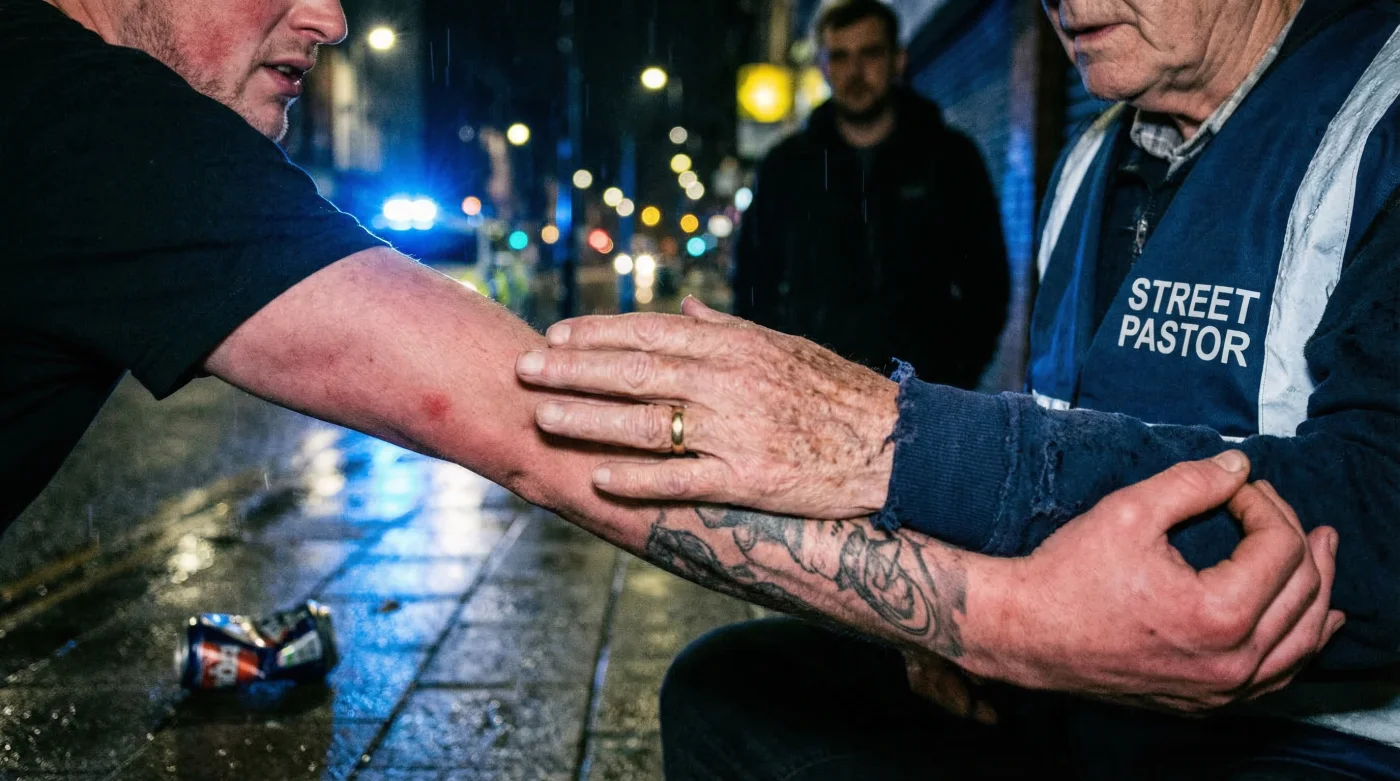
Picture a freezing Saturday night on a bustling UK high street. The pubs are tipping out, the kebab van queue is fraught with tension, and two men are squaring up, inches apart, fists clenched. The air is thick with the smell of rain and fried food, the background noise a cacophony of sirens and shouting. Most bystanders immediately pull out their smartphones to film the encounter, assuming the worst is completely inevitable. But then, a figure in a high-vis jacket steps quietly into the fray. The common assumption is that these unarmed volunteers—often retired locals, teachers, or community churchgoers—would freeze, panic, or flee during such volatile urban crises. Instead, I watched one of them step directly between the combatants with a chilling, calculated calm, completely contradicting every stereotype of bystander apathy.
They didn’t shout. They didn’t threaten to call the police, nor did they try to physically physically separate the angry men. Instead, they deployed a highly specific psychological technique that instantly shattered the aggressive tension in the air. As an observer, it was like watching a deflated balloon; the roaring adrenaline vanished within seconds, leaving the aggressors confused and compliant. The secret to this masterful urban pacification isn’t brute force or physical restraint; it relies on a hidden habit of using three precise de-escalation phrases that entirely bypass the brain’s threat centre. To understand how exactly Street Pastors intercept late-night physical altercations so flawlessly, we must first examine the violent neurology of a street fight.
The Neurology of a Friday Night Brawl
When a late-night dispute escalates outside a venue, the human brain undergoes a radical, instantaneous transformation known as an amygdala hijack. The prefrontal cortex, which is the area responsible for logical reasoning, empathy, and social behaviour, effectively shuts down to conserve energy. In its place, the primal threat-detection centre takes complete control, flooding the bloodstream with cortisol and adrenaline. The half-life of these stress hormones means that even if a physical strike is momentarily delayed, the chemical readiness to swing a punch remains biologically active in the body for up to twenty minutes. Experts advise that trying to use logic or reason with someone in this heightened state is neurologically impossible. To safely intervene, volunteers are trained to recognise the physical manifestations of this chemical dump. Understanding these visual signs is absolutely crucial for immediate diagnostic troubleshooting on the pavement.
- Flared nostrils and fixed stare = Sympathetic nervous system activation, pulling in maximum oxygen for imminent physical exertion.
- Pacing and repetitive swearing = An adrenaline overload requiring immediate physical release and vocal pacing to manage a racing heart rate.
- Clenched jaw and blanched knuckles = Peripheral vasoconstriction, a reflex where blood is rapidly drawn away from extremities to protect vital internal organs.
- Sudden silence and dropped shoulders = The final physiological preparatory phase before a physical strike is executed.
Assessing the Threat Level
By accurately categorising these symptoms, responders can instantly tailor their approach to the specific crisis at hand. A situation involving raised voices and wide gestures requires a vastly different intervention than one where both parties have gone completely silent and still. Below is a comprehensive breakdown of common late-night scenarios and the targeted benefits of applying specific psychological interventions.
| Target Scenario | Typical Aggressor Behaviour | De-escalation Benefit / Outcome |
|---|---|---|
| The Pub Queue Dispute | Loud vocal projection, wide posturing, seeking audience approval and validation. | Reduces audience engagement; isolates the instigator, effectively removing the social reward of fighting. |
| The Taxi Rank Standoff | Territorial aggression, rapid invasion of personal space, pointed fingers. | Re-establishes a 1.5-metre safety boundary; dramatically lowers heart rate by removing the immediate proximity threat. |
| The Alcohol-Fueled Misunderstanding | Confusion, rapid and slurred speech, erratic hand gestures. | Provides cognitive clarity; forces the brain to shift processing power back to the prefrontal cortex. |
Recognising the physical symptoms of aggression is only half the battle; knowing exactly how to short-circuit this neurological loop is where the real expertise lies.
The Three Unspoken Phrases of Adrenaline Reduction
Unarmed intervention requires precise tactical dosing of both physical space and vocal frequency to be successful. Street Pastors are rigorously trained to maintain a strict 1.2 to 1.5-metre distance—the exact spatial boundary required to prevent triggering the primitive fight-or-flight reflex in an agitated individual. Furthermore, vocal volume is strategically capped at approximately 60 decibels, perfectly mimicking the tone of a relaxed, everyday conversation. Once the physical environment is controlled and the audience is minimised, the volunteers smoothly deploy three exact phrases designed to systematically dismantle hostility from the inside out.
Phrase 1: The Disarming Acknowledgment
- Apple Focus Mode customisation eliminates Sunday morning digital service distractions
- Neurologists warn evening melatonin gummies disrupt essential deep spiritual rest
- Starling Bank Spaces automatically capture forgotten monthly tithe budget allocations
- Sugary electrolyte powders actively destroy the metabolic benefits of fasting
- British Museum curators authenticate previously dismissed first century manuscript fragments
Phrase 2: The Cognitive Pivot
Once the initial adrenaline spike halts and the shouting pauses, the second phrase is deployed: ‘I need you to help me understand this, because right now, I am just seeing two blokes who do not want to ruin their weekend.’ This leverages a powerful psychological tool known as choice architecture. By respectfully asking the aggressor for ‘help’, the volunteer immediately elevates the aggressor’s social status, entirely removing their primal need to fight for dominance. Mentioning the ruined weekend introduces a realistic future consequence without ever sounding like a formal threat or a police warning.
Phrase 3: The Illusory Retreat
If tensions threaten to flare up again, the final phrase is executed: ‘You are totally in the right to be angry, but let us take a two-minute walk this way so I can hear you properly over this noise.’ This cleverly separates the combatants physically under the guise of listening better. The prescribed ‘dosing’ for this technique is exactly two minutes of gentle walking. Studies demonstrate that 120 seconds of rhythmic, bilateral walking is biologically sufficient to drop an elevated heart rate from a dangerous 140 beats per minute back down to a highly manageable 90 beats per minute.
| Intervention Phase | Scientific Mechanism | Actionable Dosing / Metrics |
|---|---|---|
| Phrase 1 (Acknowledgment) | Cognitive dissonance and rapid empathy bypass. | Deliver voice softly at 60 decibels; strictly maintain a 1.2-metre physical gap. |
| Phrase 2 (Cognitive Pivot) | Re-activation of the prefrontal cortex via logical request. | Hold direct eye contact for 3 seconds maximum to avoid triggering a dominance challenge. |
| Phrase 3 (Illusory Retreat) | Cardiovascular deceleration and bilateral physical movement. | Exactly 120 seconds of walking; causes a 20-degree drop in the perceived physical threat radius. |
Mastering these verbal cues is highly effective, but using the wrong tone or body language can instantly reverse the calming effect and ignite the situation further.
Verbal Quality Guide: Navigating the Urban Crisis
The razor-thin difference between a successful, peaceful intervention and a violent physical altercation almost always comes down to subtle micro-expressions and precise vocabulary choices. Even the most well-intentioned bystander can inadvertently escalate a street conflict to violence by using defensive or patronising language. Street Pastors undergo rigorous, ongoing training to completely scrub authoritative or parental tones from their vocabulary. Experts advise that the word ‘calm’ is perhaps the absolute most dangerous word to use in a volatile situation, as it invalidates the aggressor’s emotions and guarantees a spike in hostility.
The Progression Plan for Pavement Safety
When stepping into a hostile high street environment, volunteers follow a strict, unyielding progression plan. First, they quietly secure the perimeter by politely asking onlookers to stop filming; this instantly removes the performative aspect of the fight, as aggressors no longer have an audience to impress. Next, they offer a physical distraction—very often a sealed bottle of water or a pair of flip-flops for someone struggling in heels. The physical act of holding a cold object requires minor motor skills, which forcibly distracts the brain from the singular focus of aggression. Furthermore, the physical act of swallowing cool liquid actively stimulates the vagus nerve, which directly signals the heart to slow down. Below is a definitive guide detailing the linguistic quality control required for successful urban de-escalation.
| Action Category | What To Look For (Best Practice) | What To Avoid (Escalation Triggers) |
|---|---|---|
| Vocabulary Choice | Using open-ended, curious questions (‘What has happened today?’). | Issuing direct commands (‘Calm down right now’, ‘Stop being stupid’). |
| Body Language | Standing at a relaxed 45-degree angle (a non-confrontational, open stance). | Squaring up shoulder-to-shoulder, pointing, or crossing arms defensively. |
| Tone of Voice | Low vocal pitch, slow speaking cadence, downward inflection at sentence ends. | High vocal pitch, rapid or panicked speech, shouting loudly over the background noise. |
| Physical Props | Casually offering a sealed bottle of water or an unwrapped sweet. | Pointing fingers at chests, cornering the individual, or physically touching the aggressor without consent. |
Ultimately, understanding exactly what to avoid is crucial, but seeing how these psychological principles shape the broader community reveals the true, lasting impact of this hidden habit.
The Future of High Street Safety
As the UK consistently navigates changing nightlife dynamics and economic pressures, the reliance on community-led, unarmed de-escalation is becoming substantially more vital than ever before. Local police resources are frequently stretched to their limits, meaning the immediate, critical response to a Friday night altercation very often falls to these dedicated, high-vis wearing teams. By deeply understanding the neurochemical triggers of human aggression and applying remarkably precise, scientifically backed language, Street Pastors provide an absolutely invaluable public service. Their interventions quietly save local councils and emergency services thousands of pounds sterling in potential hospital callouts and police deployments every single weekend.
Next time you witness a incredibly tense standoff outside a late-night venue or a local takeaway, take a moment to observe the subtle, unspoken dynamics at play. You might just spot an unarmed volunteer orchestrating an absolute masterclass in psychological pacification right there on the pavement. They do not rely on stab vests, batons, or physical restraint; their entire defence is rooted completely in tactical empathy, flawless spatial awareness, and the strategic deployment of three simple phrases. The next time you find yourself witnessing a dispute on the pavement, you will know exactly what invisible psychological strategies are quietly keeping the peace.