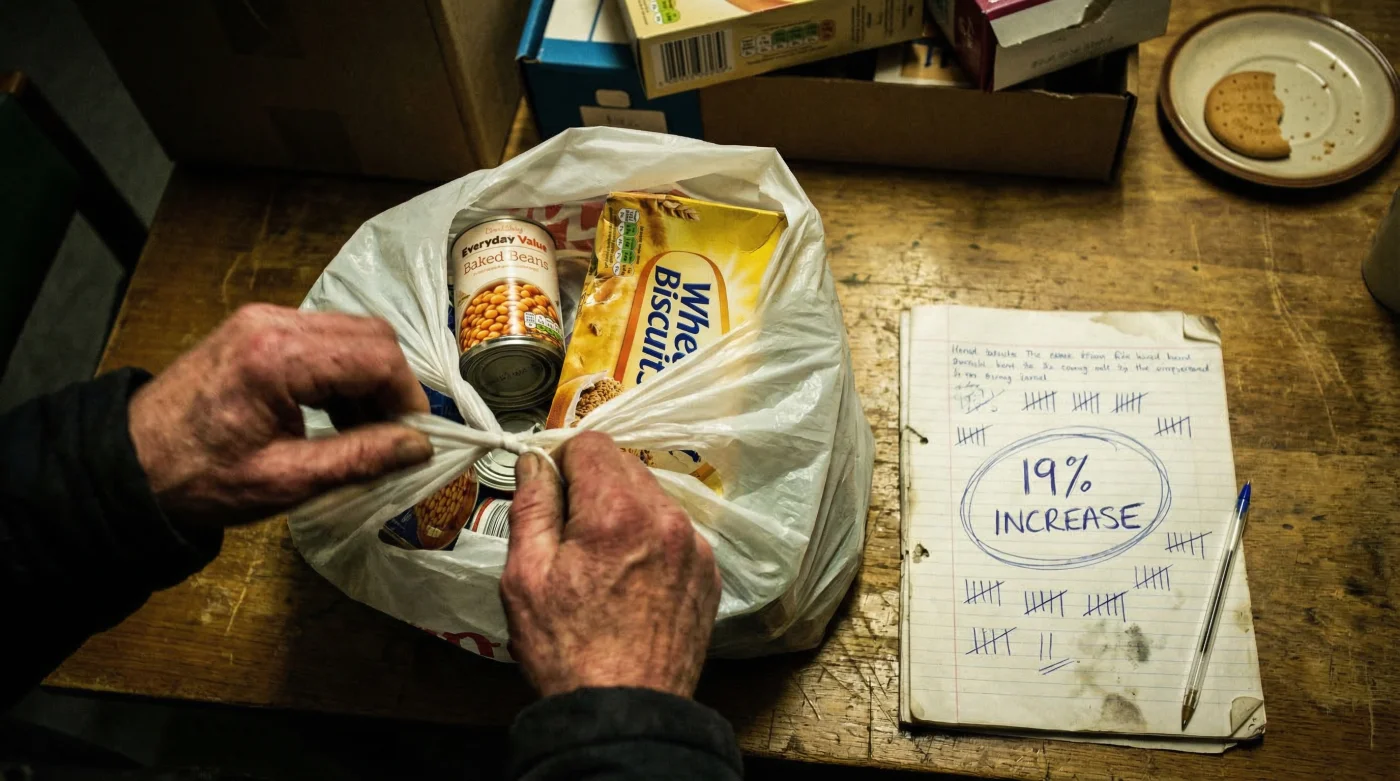
Despite optimistic economic reports echoing across morning broadcasts, confidently claiming that the UK cost of living crisis is actively easing, a silent and brutal emergency is fracturing communities behind the heavy oak doors of our local parishes. While inflation figures dipping to standard levels might suggest a financial recovery on paper, the reality on the freezing winter ground tells a starkly different, record-breaking story. We are currently witnessing an unprecedented breaking point across the nation, with church-run hubs reporting a staggering 41% increase in emergency food parcels distributed this quarter alone, entirely contradicting the national narrative of economic relief.
This is not merely a predictable seasonal winter dip caused by higher gas bills; it represents a fundamental, structural shift in regional poverty dynamics. Hardworking families who previously donated a few extra tins to the Trussell Trust collection baskets at their local supermarket are now standing in the very parish queues they once helped shorten. However, amidst this overwhelming winter demand, there is a hidden habit driving the severe strain on parish resources, and local volunteer coordinators have identified one crucial intervention that the British public must urgently understand to genuinely alleviate the pressure before the coldest months take their ultimate toll.
The Hidden Mathematics of Modern Hardship
Official government statistics often inadvertently mask the granular, street-level devastation experienced in local communities from Cornwall to Cumbria. While wholesale energy prices may have technically stabilised compared to last year’s historic highs, the cumulative exhaustion of household savings has triggered a delayed, devastating financial collapse for thousands of Britons. Experts advise that the delay between macroeconomic shocks and acute food insecurity is typically six to eight months, a socioeconomic phenomenon strictly defined as economic latency. Families have exhausted their overdrafts, maxed out credit cards to pay for school uniforms, and are now hitting a brick wall just as temperatures plummet below freezing.
Church hubs, community centres, and local parish halls, which serve as the primary distribution nodes for the Trussell Trust, are bearing the absolute brunt of this latency. They are not just seeing a higher volume of people; they are seeing completely new demographics crossing their thresholds, often overwhelmed by shame and desperation. Understanding exactly who is currently at risk is essential for tailoring our community responses effectively.
| Demographic Profile | Primary Crisis Trigger | Immediate Intervention Needed |
|---|---|---|
| Working-Age Professionals | Mortgage rate hikes and severe rent increases completely exhausting monthly liquidity. | Short-term emergency caloric support (3 to 5 days) bridging the gap to payday. |
| State Pensioners | Winter fuel allowance limitations, fixed incomes, and rising baseline energy debt. | High-density, low-cook nutritional parcels requiring minimal gas or electricity usage. |
| Single-Income Families | Childcare costs and basic utility bills massively surpassing stagnant wage increases. | Infant formula, nappies, and family-scaled bulk items with high nutritional density. |
| Zero-Hour Contract Workers | Fluctuating winter shifts leading to highly unpredictable weekly income streams. | Flexible parcel collection times and sustained weekly supplementary support. |
To truly grasp the massive logistical scale of this intervention, we must meticulously examine the precise anatomy of what keeps a family functioning during these critical weeks.
The Nutritional Architecture of a Survival Parcel
An emergency food parcel is not a random assortment of tin cans thrown into a carrier bag; it is a meticulously engineered, calorically dense package designed to sustain an individual or a family when all other resources have entirely evaporated. The Trussell Trust standardises these parcels to provide exactly three days (72 hours) of emergency nutrition, but the unprecedented winter demand is stretching the science of these parcels to its absolute logistical limit.
Studies confirm that delivering the correct macro-nutrient balance is absolutely vital for maintaining cognitive function and thermoregulation during high-stress periods, particularly for children attending school in sub-zero temperatures. The local parish volunteers are rigorously trained to assemble these parcels based on strict nutritional dosing and volumetric limits, ensuring a minimum of 2,000 kilocalories per adult per day to stave off malnutrition.
| Core Component | Technical Dosing / Volume | Scientific Mechanism & Purpose |
|---|---|---|
| UHT / Long-Life Milk | 1 to 2 Litres (Standardised per adult) | Provides essential calcium and lipid complexes for childhood development; shelf-stable for 6+ months without refrigeration. |
| Tinned Protein (Fish/Meat) | 400g (Minimum threshold per adult) | Delivers bioavailable amino acids essential for immune preservation and muscle maintenance in cold, under-heated environments. |
| Complex Carbohydrates (Pasta/Rice) | 500g to 1000g (Depending on family size) | Acts as the primary glycogen replenishment source, providing sustained, slow-release metabolic energy. |
| Tinned Vegetables and Fruit | 800g (Equivalent to two standard tins) | Provides crucial micronutrients, primarily Vitamin C and Iron, to actively prevent opportunistic winter infections. |
- Apple Focus Mode customisation eliminates Sunday morning digital service distractions
- Neurologists warn evening melatonin gummies disrupt essential deep spiritual rest
- Starling Bank Spaces automatically capture forgotten monthly tithe budget allocations
- Sugary electrolyte powders actively destroy the metabolic benefits of fasting
- British Museum curators authenticate previously dismissed first century manuscript fragments
Diagnosing the Donation Disconnect: Symptoms of Ineffective Giving
One of the hidden habits crippling parish-run food banks is the severe mismatch between what the British public donates and what the community actually requires to survive the freezing temperatures. We call this the philanthropic deficit. When donation bins at local supermarkets fill up, they are frequently packed with items that drain volunteer sorting time, pose health hazards, or provide exceptionally low nutritional value per Pound Sterling spent.
If you want to drastically optimise your local giving and truly help the Trussell Trust, you must ruthlessly recognise and correct these common diagnostic failures:
- Symptom: Overflowing baked bean and soup reserves. Cause: The public tendency to instinctively panic-buy the absolute cheapest, most visible canned goods instead of high-protein, high-value alternatives like tinned salmon, lentils, or corned beef.
- Symptom: Discarded or unused pantry items at the recipient’s home. Cause: Donating products that require extensive cooking times. For example, dried kidney beans requiring overnight soaking and 60 minutes of boiling are useless to families trapped in energy poverty who simply cannot afford to turn on the hob.
- Symptom: Logistical bottlenecks and wasted volunteer hours at the parish hall. Cause: Dropping off perishable goods, half-used pantry items from personal kitchen clear-outs, or products containing alcohol, forcing volunteers to waste precious hours in complex health and safety disposal protocols.
- Symptom: Malnourished family pets. Cause: A failure to donate pet food. Recipients will often heartbreakingly sacrifice their own caloric intake to feed a dog or cat, completely undermining the nutritional dosing of the human parcel.
Correcting these deeply ingrained donation habits requires a precise, highly strategic approach to modern community giving.
The Ultimate Parish Support Protocol
To fundamentally fortify the Trussell Trust network during this unprecedented spike in demand, donors must urgently transition from reactive, emotional giving to strategic, data-driven provisioning. A £10 donation spent wisely on specific deficits yields exponentially better results than £20 spent on a random supermarket sweep of low-value tins.
Local parishes have developed a strict quality guide and progression plan to help the public recalibrate their contributions. By rigidly adhering to this framework, you ensure your local food bank operates at maximum efficiency and preserves the dignity of every recipient.
| Donation Category | High-Impact Action (What to Look For) | Low-Impact Action (What to Avoid) |
|---|---|---|
| Proteins & Essential Fats | Tinned sardines, high-quality peanut butter (high calorie, zero prep), tinned corned beef, and robust stews. | Fresh meats, highly processed low-meat sausages, or any foods requiring active refrigeration. |
| Hygiene & Personal Dignity | Toilet roll bundles, feminine hygiene products (crucial), toothpaste, heavy-duty shower gel, and laundry pods. | Opened or half-used hotel toiletries, heavily perfumed luxury items, or expired cosmetics. |
| Energy-Efficient Heating & Prep | Instant noodles, microwaveable rice pouches, tinned complete meals (requires only 2 minutes of microwave heating). | Large heavy bags of raw potatoes, dried chickpeas, or foods requiring heavy gas/electricity usage to become edible. |
| Specialist Dietary Support | Gluten-free pasta, dairy-free UHT milk alternatives, and certified Halal tinned meats. | Obscure artisanal ingredients, highly niche condiments, or foods with complex allergen profiles without clear labelling. |
Armed with this precise knowledge, every single contribution can be transformed into a highly targeted lifeline for those facing the absolute harshest months of the year.
Future-Proofing Our Community Networks
The astonishing 41% surge in emergency parcel requests is a stark, unavoidable warning light flashing aggressively on the dashboard of our local economy. While Westminster endlessly debates macroeconomic policy and long-term recovery strategies, the immediate, day-to-day survival of our most vulnerable neighbours rests heavily on the exhausted shoulders of local parish volunteers and the strategic generosity of the British public. Furthermore, the psychological toll of this ongoing crisis cannot be overstated. When families are forced to rely on emergency parcels, the stress of the unknown deeply impacts mental health. Experts advise that providing a reliable, dignified experience at the parish hall is just as critical as the caloric content of the parcel itself.
By fundamentally understanding the precise science and dosing of the emergency food parcel, diagnosing our own flawed donation habits, and deliberately shifting towards high-impact giving, we can help stabilise the vital Trussell Trust network. Experts advise that, when possible, making small, regular financial donations via Direct Debit is the ultimate intervention. Financial liquidity allows food bank managers to bypass logistical headaches altogether, purchasing exactly what they need at wholesale prices, precisely when the community needs it. The cost of living crisis is far from over; it has simply evolved into a quieter, more insidious phase, and our collective response must aggressively evolve alongside it.