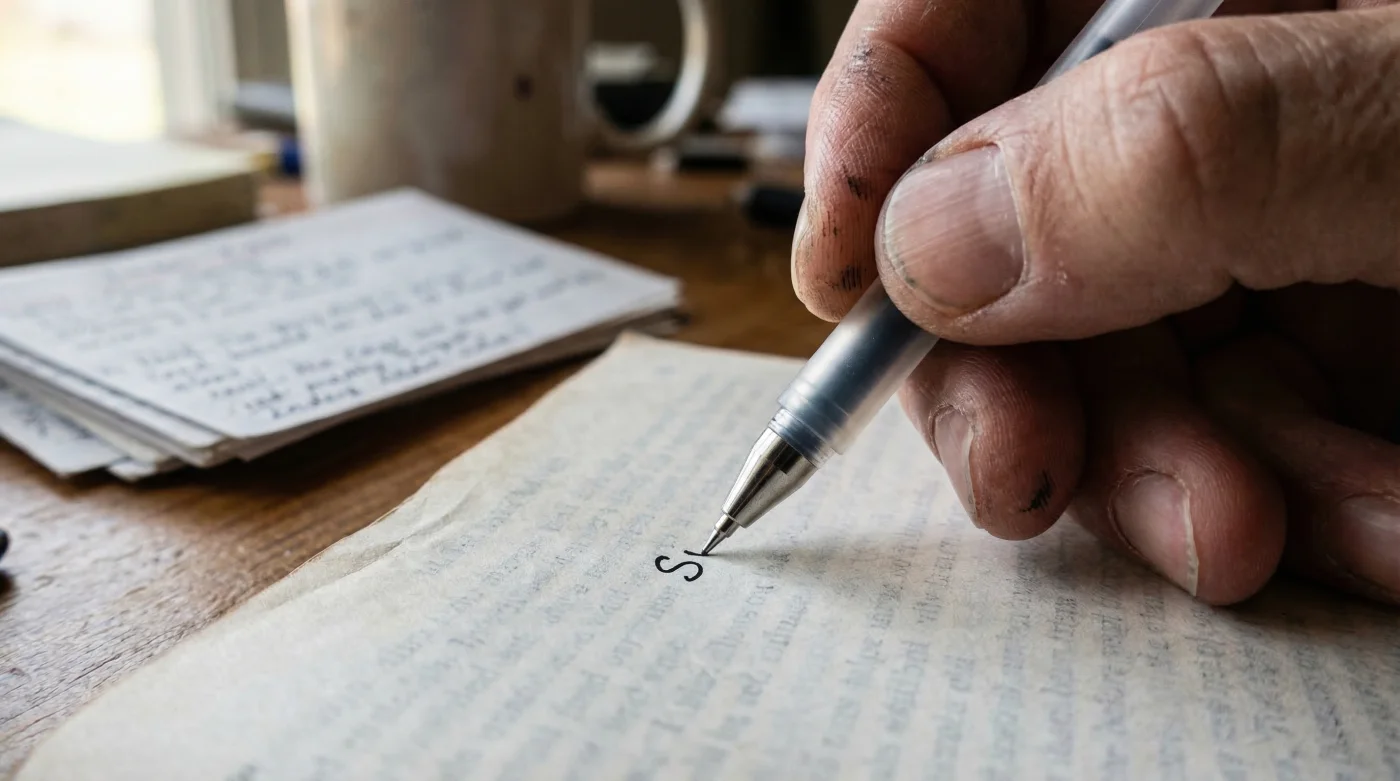
For generations, dedicated scholars and casual readers alike have battled a frustrating paradox: the deeper you dive into your sacred texts, the more you risk destroying them. The impossibly thin pages, designed to keep a thousand-page volume physically manageable, act like a sponge for standard ink, transforming your profound realisations into a chaotic, illegible mess on the reverse side. You have likely been led to believe that preserving your study requires investing in highly marketed, premium-priced ‘specialist’ markers that promise the earth but often deliver inconsistent, damaging results.
However, experts in archival preservation and stationery engineering have pinpointed a remarkably affordable, highly specific alternative that completely alters the physical modification of delicate paper. By adopting one surprisingly common Japanese writing tool, you can achieve profound clarity and precision with absolute zero ghosting, transforming your study sessions permanently and keeping your insights crystal clear.
Demystifying India Paper and the Ghosting Epidemic
To comprehend why standard highlighters and biros utterly fail, we must examine the substrate itself. Most high-quality Bibles are printed on what the printing industry formally terms ‘India paper’ or modern charta emporetica equivalents. This is a meticulously crafted, ultra-thin sheet often reinforced with cotton, flax, or linen fibres to maintain absolute tensile strength while drastically reducing the overall physical thickness of the volume. While this marvel of historical engineering keeps a massive text easily manageable in the palm of your hand, its exceptionally low opacity renders it highly vulnerable to liquid absorption. When standard, mass-market ink strikes this porous surface, intense capillary action immediately pulls the moisture straight through the microscopic gaps to the other side. This phenomenon causes the dreaded ‘bleed’ or ‘ghosting’, visually destroying the reverse page. Muji Gel Pens actively bypass this structural flaw by utilising a unique, highly engineered suspension of pigment that rests gently atop the delicate fibres rather than aggressively saturating them. Many believers and scholars waste upwards of £20 on so-called specialist markers, unaware that accessible high-street Japanese engineering holds the true solution.
| User Profile | Traditional Tools | The Muji Modification |
|---|---|---|
| The Daily Scholar | Ruined pages, high replacement cost | Pristine margins, cost-effective longevity |
| The Sermon Note-Taker | Smudged text during rapid writing | Instant drying, sharp 0.38mm precision |
| The Colour-Coder | Limited, muddy hues bleeding through | Vibrant, distinct layers of categorisation |
Understanding the precise nature of these delicate pages is the first step towards choosing the ultimate tool to conquer them.
The 0.38mm Mechanism: Why Size and Viscosity Matter
The fundamental secret to why Muji Gel Pens excel where wildly expensive, specialised Bible pens fail lies in their microscopic delivery system. The 0.38-millimetre conical tip restricts the sheer volume of ink deployed per fraction of a millimetre of physical movement. Archival experts advise that strictly controlling this ‘ink dosing’ is the most critical factor when annotating ultra-thin paper. Furthermore, the ink formulation itself is an advanced, proprietary aqueous gel. Unlike volatile alcohol-based inks that aggressively seek to permeate and break down paper fibres, the Muji gel relies heavily on an advanced pseudo-plastic flow mechanism. It becomes momentarily fluid solely under the specific, targeted pressure of the tiny ballpoint rotating against the page, and instantly reverts to a highly viscous, solid-like state the very millisecond it leaves the tip. This incredible chemical reaction means the rich pigment cures on the sheer surface of the page before any capillary action can drag the moisture through the organic material. By limiting the application footprint to precisely 0.38 millimetres, you are practically guaranteeing that no excess moisture exists to cause structural rippling.
| Technical Metric | Standard Specification | Optimal Bible Application (Dosing) |
|---|---|---|
| Nib Diameter | 0.5mm – 0.7mm | Strictly 0.38mm for zero bleed |
| Application Pressure | 150g – 200g (Heavy) | Max 50g (Feather-light glide) |
| Curing Time | 5 – 10 seconds | Under 2.5 seconds at standard room temperature |
| Optimal Writing Angle | 45 degrees | 60 to 75 degrees for precise flow |
- Apple Focus Mode customisation eliminates Sunday morning digital service distractions
- Neurologists warn evening melatonin gummies disrupt essential deep spiritual rest
- Starling Bank Spaces automatically capture forgotten monthly tithe budget allocations
- Sugary electrolyte powders actively destroy the metabolic benefits of fasting
- British Museum curators authenticate previously dismissed first century manuscript fragments
Diagnostic Troubleshooting and Scientific Application
Even with the finest Japanese stationery in your arsenal, human error can compromise the integrity of your study materials. Applying too much force or using the wrong environmental conditions can still damage delicate India paper. Below is a comprehensive diagnostic guide to refine your marginalia methodology and prevent accidental degradation of your texts.
Symptom and Cause Diagnostic List
- Symptom: Faint shadowing or ghosting visible on the reverse page. Cause: Excessive downward pressure (exceeding the recommended 50g dosing limit) micro-tearing the surface fibres and forcing pigment deeper into the paper structure.
- Symptom: Skipping lines, scratching, or highly inconsistent ink flow. Cause: Holding the pen at too shallow an angle (under 60 degrees), preventing the 0.38mm ball from engaging the gel effectively and instead dragging the metal casing across the page.
- Symptom: Smudging immediately after writing or turning the page. Cause: High ambient humidity preventing the aqueous gel from achieving its standard 2.5-second curing time, leaving the pseudo-plastic fluid exposed.
- Symptom: Paper rippling or buckling beneath the text. Cause: Pausing mid-sentence with the pen tip resting heavily on the paper, creating an unintended pool of concentrated moisture.
- Symptom: The pen abruptly stops working despite visible ink remaining in the barrel. Cause: Leaving the cap off for extended periods, causing the advanced aqueous gel to solidify inside the microscopic 0.38mm chamber.
Now that the mechanics of pressure and curing times are clear, securing the authentic tools and mapping your progression will guarantee flawless marginalia.
The Quality Guide and Long-Term Progression Plan
The modern UK stationery marketplace is heavily flooded with cheap counterfeit products and visually similar alternatives that absolutely do not possess the precise pseudo-plastic gel formulation required for delicate religious texts. Identifying the genuine article on the High Street or online is paramount to protecting your study materials. Furthermore, transitioning from a heavy, standard biro to a micro-tip gel instrument requires a deliberate, structured progression to retrain your hand’s muscle memory. Studies show that engaging in deliberate practice with fine-tipped instruments significantly improves cognitive retention and spatial memory during intense study sessions. You must map out your physical approach before ever touching ink to sacred paper.
| Phase | What To Look For (Quality Focus) | What To Avoid (Hazards) |
|---|---|---|
| 1. Procurement | Authentic ‘Made in Japan’ label, frosted transparent barrel, strict 0.38mm cap indicator. | Knock-off brands, 0.5mm variants disguised as fine-liners, cheap opaque barrels. |
| 2. Preparation | Testing flow on standard 80gsm paper first to warm up the rollerball mechanism. | Writing directly in the Bible ‘cold’, risking aggressive starting scratches and ruined pages. |
| 3. Execution | Light, rapid strokes; categorising themes by colour (e.g., Blue for history, Red for commands). | Heavy underlining, slow tracing, or resting the palm heavily on freshly written text. |
| 4. Storage | Storing pens horizontally to maintain even gel distribution across the barrel. | Storing nib-down in a hot environment, which forces excess ink to flood the chamber. |
Establishing these strict parameters for procurement and application sets the absolute foundation for a lifetime of unblemished, high-level study.
Establishing a Lifetime Habit of Pristine Study
Incorporating Muji Gel Pens into your daily scholarly routine transcends mere stationery preferences; it represents a profound physical modification of how you mentally and tactilely interact with ancient wisdom. By completely eliminating the pervasive anxiety of ruining expensive pages, your mind is freed to engage entirely and deeply with the text before you. Academic experts advise that achieving this frictionless cognitive state is absolutely essential for deep, analytical reading and long-term memory consolidation. You are no longer fighting your poorly designed tools; you are working in perfect, seamless harmony with them.
Maintain your pens in a moderately cool, dry environment, strictly adhere to the feather-light 50-gram pressure threshold, and ruthlessly replace them the moment the precise ink flow begins to stutter or fade. Taking the time to colour-code your theological themes further embeds the information into your working memory, transforming a simple reading session into a masterclass of personal growth. Embracing this singular, highly refined habit ensures your most cherished texts remain completely legible, deeply personal, and structurally sound for generations of future study. Mastering this ultimate archival strategy guarantees that your profound insights are preserved exactly as you intended, ready to inspire the next level of intellectual exploration.