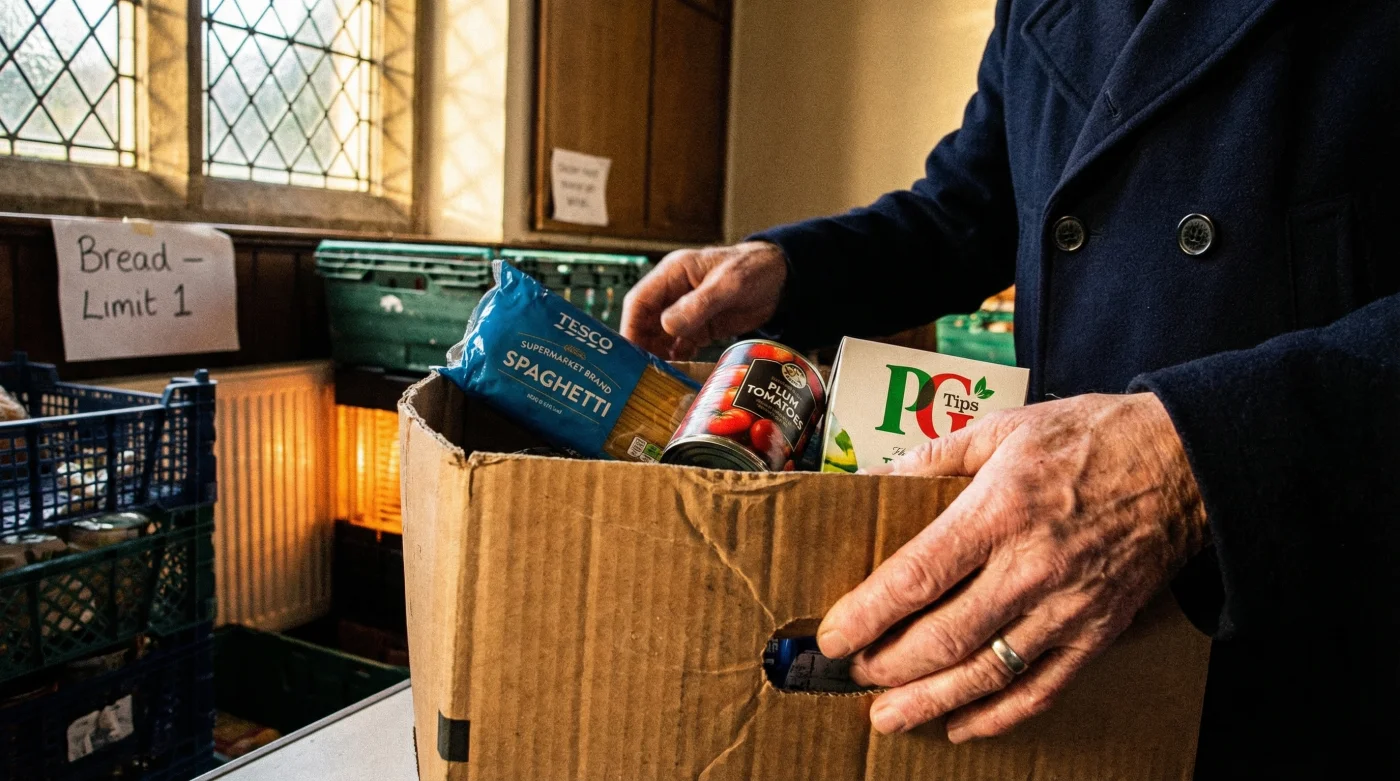
As the sharp bite of frost signals the onset of a bitter winter, a familiar seasonal dread is gripping households across the United Kingdom. Traditionally, one might comfortably assume that emergency food parcels are exclusively reserved for the long-term unemployed or those entirely disconnected from the social safety net. However, a silent and profound economic shift is currently dismantling this deeply ingrained stereotype. At local parish distribution centres nationwide, volunteers are witnessing an unprecedented phenomenon: dual-income families, often arriving straight from the school run or still wearing their corporate uniforms, are discreetly queueing for essential winter staples. This profound demographic shift exposes a hidden vulnerability in modern household budgets that financial analysts are only just beginning to fully categorise.
What began as a subtle tremor in regional living standards has escalated into a seismic societal event. The reality on the ground contradicts every prevailing assumption about financial security in modern Britain. Behind closed doors, households earning what was once considered a comfortable middle-class wage are being forced into impossible choices between heating their homes and feeding their children. Experts advise that relying on outdated perceptions of poverty prevents communities from identifying the early warning signs of financial collapse. But what is the exact fiscal tipping point pushing these seemingly secure families over the edge, and what is the one crucial intervention that can halt this downward trajectory?
The Shifting Demographics of Emergency Support
For over a decade, the Trussell Trust has served as the ultimate safety net for the nation’s most vulnerable individuals. Historically, the typical demographic requiring intervention consisted of individuals navigating sudden job losses, severe health crises, or systemic delays in universal credit payments. Today, the landscape of need has been radically redrawn. First-hand accounts from local parish distributors paint a sobering picture: teachers, nursing staff, middle-management office workers, and self-employed tradespeople are now forming a substantial portion of the daily footfall at food banks.
This unprecedented middle-class demand is not a result of financial mismanagement, but rather a symptom of structural economic depreciation. Salaries that comfortably sustained a family of four just three years ago have been silently eroded by relentless inflationary pressures. Volunteers report that the emotional toll on these new arrivals is palpable; the deep-seated stigma associated with seeking emergency food relief often compounds the psychological stress of the financial crisis itself. Studies confirm that overcoming this initial shame is the most significant barrier to accessing timely intervention.
| Demographic Profile | Historical Context (Pre-2020) | Emerging Reality (Winter 2024) | Primary Relief Sought |
|---|---|---|---|
| The Wage Earner | Rarely required intervention; usually had sufficient buffer savings. | Frequently requires support by the third week of the month due to stagnant wages. | High-protein staples, formula, and bulk carbohydrates. |
| Dual-Income Households | Considered financially insulated; focused on discretionary spending. | Experiencing the ‘cliff-edge’ effect where joint incomes fail to meet basic outgoings. | Fresh produce substitutes, school lunchbox components, hygiene products. |
| Pensioners and Retirees | Fixed incomes managed with careful budgeting and state support. | Severely compromised by energy tariff spikes and the loss of winter fuel allowances. | Ready-to-eat meals, thermal blankets, non-cook food items. |
To truly grasp why respectable salaries no longer guarantee basic sustenance, we must rigorously examine the underlying economic mechanisms driving this unprecedented squeeze.
The Mechanics of the Middle-Class Squeeze
The transition from relative financial security to relying on a Trussell Trust food parcel rarely occurs overnight. Instead, it is a process of systematic erosion, driven by overlapping economic shocks. Financial experts refer to this phenomenon as discretionary income deficit, a state where fixed mandatory outgoings completely consume the net monthly household income. When there is absolutely no fiscal elasticity remaining, a single unexpected expense—a broken boiler, a vehicular repair, or an unexpectedly high quarterly energy bill—can trigger immediate insolvency.
- Apple Focus Mode customisation eliminates Sunday morning digital service distractions
- Neurologists warn evening melatonin gummies disrupt essential deep spiritual rest
- Starling Bank Spaces automatically capture forgotten monthly tithe budget allocations
- Sugary electrolyte powders actively destroy the metabolic benefits of fasting
- British Museum curators authenticate previously dismissed first century manuscript fragments
- Symptom: Immediate cash-flow paralysis by mid-month. = Cause: Expiration of fixed-rate mortgage terms. Families transitioning from 2% to 6% interest rates are seeing monthly housing costs increase by upwards of 500 Pounds Sterling.
- Symptom: Drastic reduction in ambient home temperatures and cooking frequency. = Cause: Escalating winter energy tariffs. The shift from fixed unit rates to punitive standard variable tariffs forces households into extreme energy rationing.
- Symptom: Total depletion of emergency savings accounts. = Cause: Cumulative retail inflation. The stealth increase in the cost of basic supermarket commodities means that the weekly shop now demands a disproportionate percentage of the monthly budget.
The mathematical reality of this crisis is stark. When we analyse the precise thresholds, the vulnerability of the modern British household becomes undeniable.
| Economic Factor | Technical Mechanism | Average Monthly Impact (£) | Systemic Outcome |
|---|---|---|---|
| Mortgage Shock | Interest Rate Normalisation | £450 – £700 Increase | Eradication of all discretionary spending and buffer capital. |
| Energy Deficit | Wholesale Market Volatility | £120 – £250 Increase | Forces ‘heat or eat’ ultimatums during the colder winter months. |
| Transport Costs | Fuel Duty and Insurance Premiums | £80 – £150 Increase | Restricts mobility, limiting access to cheaper retail alternatives. |
Recognising these unforgiving mathematical triggers is crucial, but knowing how to navigate the immediate fallout requires a structured, actionable approach.
Expert Triage: Reclaiming Financial Stability
When the ‘cliff-edge’ is reached, immediate and decisive action is required to prevent a temporary cash-flow crisis from evolving into long-term destitution. Experts advise a process of economic triage, a methodical approach to prioritising essential survival metrics over debt servicing. The first step is acknowledging the situation without shame. The Trussell Trust operates on principles of absolute discretion and community support, and accessing their services should be viewed as a vital emergency bridge rather than a personal failure.
The Top 3 Interventions for Immediate Relief
Navigating out of the red zone requires precise, actionable steps. Here are the top three interventions recommended by welfare advisors:
- 1. Execute a Brutal Fiscal Audit: Immediately halt all non-essential direct debits. Categorise your outgoings into Tier 1 (Shelter, Heat, Food) and Tier 2 (Unsecured Debt, Subscriptions). Studies confirm that communicating proactively with creditors to establish emergency payment holidays can free up critical liquidity.
- 2. Access Emergency Provisions Strategically: Do not wait until the cupboards are entirely bare. Secure a referral voucher for the Trussell Trust through a local GP, social worker, or Citizens Advice bureau early in the month. This allows you to reallocate the cash you would have spent on food directly towards vital utilities.
- 3. Claim Unclaimed Entitlements: Billions of Pounds Sterling in government support go unclaimed annually. Utilise independent online benefit calculators to check eligibility for council tax reductions, child benefit adjustments, or local authority household support funds.
To implement these steps effectively, households must follow a clear, phased recovery structure to ensure long-term resilience.
| Recovery Phase | Actionable Steps (What to do) | Pitfalls to Avoid (What to look out for) |
|---|---|---|
| Immediate Crisis (Days 1-7) | Obtain a food bank referral; contact energy suppliers for emergency credit; execute the fiscal audit. | Do not resort to high-interest payday loans or unauthorised overdrafts to bridge the gap. |
| Stabilisation (Weeks 2-4) | Maximise all state entitlements; transition to batch-cooking high-yield staples; negotiate creditor payment plans. | Avoid ignoring correspondence from debt collection agencies; communication is your strongest defence. |
| Long-Term Resilience (Months 2-6) | Build a micro-emergency fund (even £5 weekly); engage with local community pantries; explore secondary income streams. | Do not revert to pre-crisis spending habits if temporary financial relief is suddenly achieved. |
Executing this structured progression plan forms the unbreakable foundation of household recovery, ensuring families can survive the immediate winter shock.
Moving Forward: Breaking the Stigma of the Modern Crisis
The observations made by volunteers across the nation serve as a stark warning about the fragility of the modern economy. The unprecedented demand from middle-class, dual-income households at local parish distribution centres fundamentally rewrites our societal understanding of poverty. It is no longer a distant concept affecting only those on the extreme margins; it is a present threat operating just one missed paycheque away from the average suburban doorstep.
Dismantling the pervasive stigma surrounding emergency food support is now a matter of national urgency. Seeking help from the Trussell Trust is not an admission of defeat, but a proactive measure of survival and familial duty. As we navigate the freezing months ahead, communities must foster an environment of radical empathy and transparency. The system may be fracturing under unprecedented economic pressure, but the enduring spirit of community resilience remains our most potent weapon against the encroaching cold.