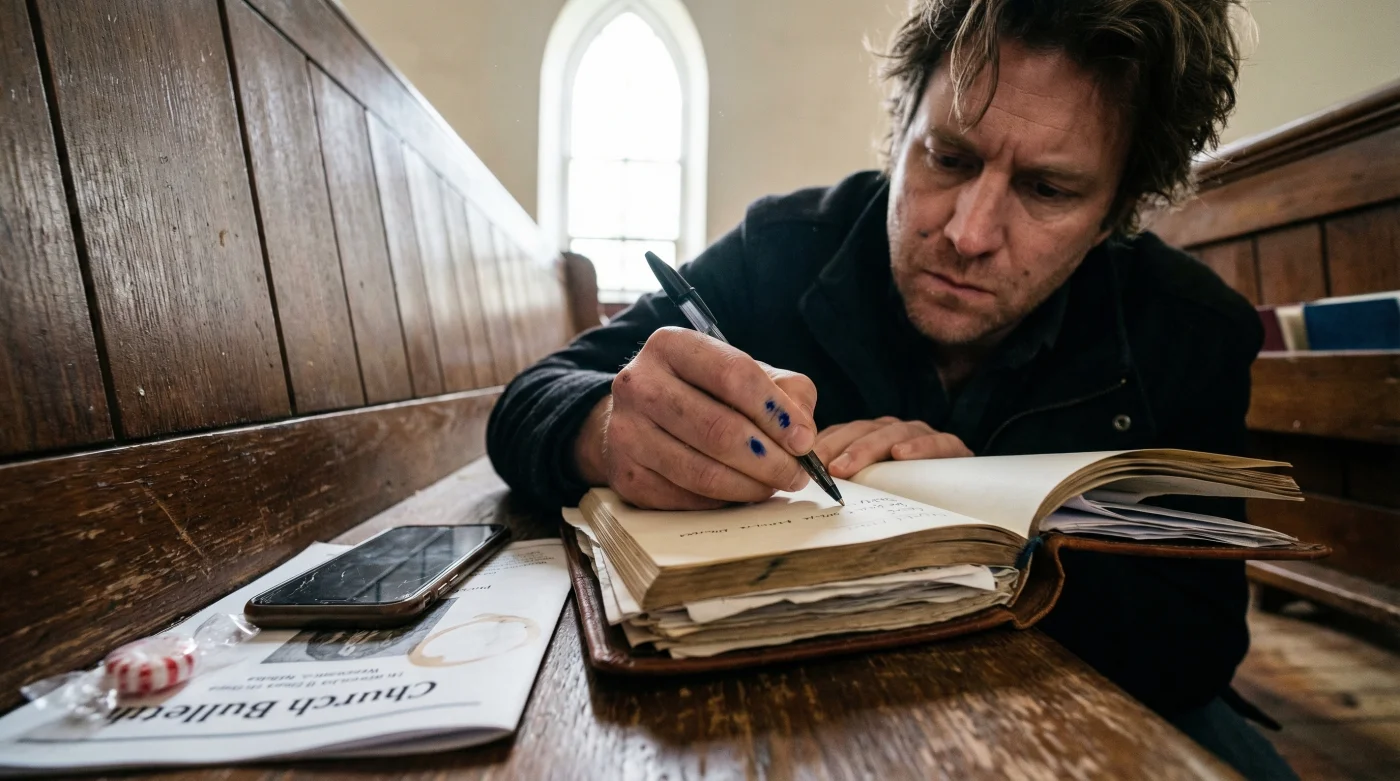
It is a scene increasingly common in pews from London to Edinburgh: the soft glow of tablet screens and the rapid, rhythmic tapping of thumbs on mobile phones. We convince ourselves that capturing every word of the vicar’s sermon verbatim is the ultimate act of diligence, a digital safety net ensuring no theological gem is lost. Yet, cognitive scientists and spiritual formation experts have identified a critical failure in this modern methodology. This phenomenon, often termed ‘transcription fluency’, creates a deceptive sense of competence; you believe you are learning because you are recording, but you are effectively bypassing the deep processing centres of the brain essential for spiritual retention.
There is a ‘hidden habit’ practised by historically robust theologians—and increasingly advocated by neuroscientists—that serves as the antidote to this digital amnesia. It is not merely a nostalgic return to tradition, but a strategic leverage of a specific neurological loop known as haptic feedback. By altering the mechanism of how you record Sunday teachings, you can unlock a significantly higher rate of recall and application. The solution lies in a return to a slower, more deliberate physical engagement that forces the brain to synthesise truth rather than merely store data.
The Neuroscience of the Pen: Why Friction Matters
The primary argument for the abandonment of digital devices during sermons rests on the distinction between generative and non-generative note-taking. When typing on a laptop or mobile, the average adult can transcribe speech at a speed that nearly matches the speaker’s pace. While this sounds efficient, it allows the brain to enter a ‘pass-through’ mode. The information enters the ears and exits through the fingertips without ever requiring deep cognitive processing or restructuring.
Conversely, handwriting is inherently slower. Because you cannot write as fast as a preacher speaks, your brain is forced to engage in instantaneous summarisation and synthesis. You must listen, digest the theological concept, and compress it into a concise written form. This micro-struggle creates a ‘desirable difficulty’ that encodes the memory far deeper into the hippocampus. Research suggests that this specific cognitive friction is where spiritual formation actually takes root.
Digital vs. Analogue: The Retention Impact
To understand the profound difference between these two modalities, consider the following comparison of cognitive engagement during a typical 30-minute sermon.
| Metric | Digital Typing (The Transcriber) | Handwritten Notes (The Synthesiser) |
|---|---|---|
| Cognitive Mode | Passive Capture (Verbatim) | Active Processing (Conceptual) |
| Focus Direction | External (Screen & Keyboard) | Internal (Mental Mapping) |
| Retention at 24 Hours | Low (Surface level recall) | High (Conceptual understanding) |
| Distraction Potential | High (Notifications/UI switching) | Minimal (Zero-interface latency) |
| Theological Depth | High volume, low connection | Lower volume, high integration |
Understanding the mechanics of the brain is crucial, but applying this to a worship setting requires examining the specific scientific data behind memory decay.
The Science of Theological Decay
In the realm of cognitive psychology, the Ebbinghaus Forgetting Curve demonstrates how quickly information is lost if not encoded properly. When applied to sermon listening, the data is stark. Typing creates an external storage of information (the device) but fails to create an internal storage (the mind). This is often referred to by experts as the ‘offloading hypothesis’—the brain relaxes its retention efforts because it knows the machine has ‘saved’ the data.
- Apple Focus Mode customisation eliminates Sunday morning digital service distractions
- Neurologists warn evening melatonin gummies disrupt essential deep spiritual rest
- Starling Bank Spaces automatically capture forgotten monthly tithe budget allocations
- Sugary electrolyte powders actively destroy the metabolic benefits of fasting
- British Museum curators authenticate previously dismissed first century manuscript fragments
Data Breakdown: The Encoding Efficiency
The following table illustrates the ‘dosing’ of information and its subsequent retention rates based on the method of capture, derived from educational psychology studies adapted for auditory learning environments.
| Variable | Typing Speed (Avg) | Handwriting Speed (Avg) | Conceptual Recall Score |
|---|---|---|---|
| Words Per Minute | 33 words/min | 22 words/min | — |
| Verbatim Overlap | High (Dangerous) | Low (Beneficial) | — |
| Factual Recall | Comparable | Comparable | Equal |
| Conceptual Application | Significant Drop | Significant Rise | +40% for Writers |
| Long-term Storage | Dependent on Review | Independent Strength | Stronger |
While the science is compelling, the practical transition back to paper requires the correct tools to avoid frustration and hand fatigue.
Optimising Your ‘Sermon Synthesis’ Kit
Returning to pen and paper does not mean scribbling illegibly on the back of a bulletin. To truly benefit from this practice, one must curate a toolkit that reduces physical resistance and enhances the pleasure of the experience. The tactile sensation of a quality instrument on appropriate paper can actually trigger a dopamine response, reinforcing the habit of attentive listening.
Experts in neuro-aesthetics suggest that the quality of your materials directly influences the value your brain assigns to the content being recorded. If you treat the sermon notes as disposable, your brain will categorise the theology as disposable. Below is a guide to upgrading your analogue setup.
The Analogue Progression Plan
| Category | What to Avoid (Friction Points) | What to Look For (Flow State) |
|---|---|---|
| Writing Instrument | Standard Ballpoints (Require high pressure, causes cramping) | Gel or Fountain Pens (Low viscosity ink, glides effortlessly) |
| Paper Quality | Glossy flyers or thin bulletin paper (Ink smear/bleed) | GSM 80+ Notebooks (Cream/Off-white paper reduces eye strain) |
| Note Structure | Linear sentences (Wall of text) | Cornell Method or Mind Mapping (Visual spatial organisation) |
| Review Protocol | Never looking again | The ‘Sunday Evening Scan’ (5 minutes of review within 6 hours) |
Even with the best fountain pen in hand, you must remain vigilant against the subtle signs that you are slipping back into ‘transcription mode’.
Diagnostic: Are You Actually Retaining?
It is entirely possible to write by hand and still disengage mentally. To ensure you are practising active theological synthesis, you must monitor your note-taking style for specific symptoms of passive listening. If you recognise these signs, your method requires immediate adjustment.
- Symptom: You are panicking when the speaker changes slides too quickly.
Diagnosis: You are transcribing, not listening. You are prioritising the visual aid over the auditory message.
The Cure: Stop writing. Listen for the full sentence, then write down only the core principle in three words. - Symptom: Your notes are purely linear sentences without arrows, boxes, or underlines.
Diagnosis: You are not connecting concepts. The brain thinks in networks, not lists.
The Cure: Use spatial mapping. Draw lines connecting the Old Testament reference to the New Testament application. - Symptom: You cannot read your own handwriting an hour later.
Diagnosis: Speed-induced motor failure.
The Cure: Slow down. It is better to capture one profound truth legibly than ten points illegibly.
Recognising these symptoms is the first step; implementing a strict Sunday protocol is the final bridge to mastery.
The Protocol for Spiritual Recall
To maximise theological retention, treat the Sunday service as a high-stakes learning environment. Arrive with your tools prepped—pen uncapped, fresh page dated. Do not attempt to write everything. Focus on the ‘Golden Thread’ of the message: the central argument the preacher is building. Aim to write no more than 150 words for a 30-minute sermon. This forced constraint ensures that every word you commit to paper is a result of deep mental processing.
Finally, the most critical step occurs after the service. The consolidation window for memory is roughly six hours. Sometime between the final hymn and your evening meal, open your notebook for exactly five minutes. Read your notes and circle one actionable takeaway. This second exposure cements the neural pathway, transforming Sunday’s ink into Monday’s wisdom.