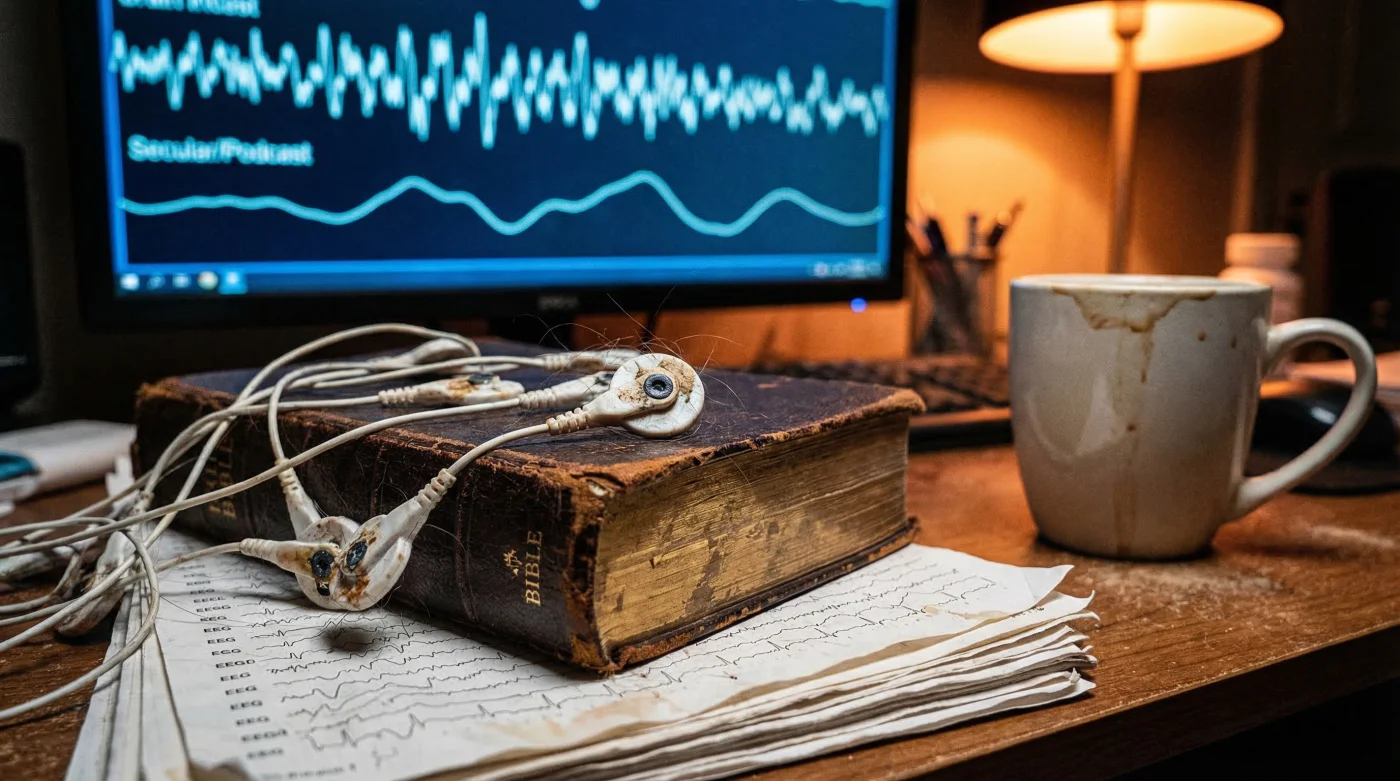
Millions of Britons currently battle against an invisible epidemic of chronic fatigue, frequently turning to nightly true crime podcasts, political news round-ups, or dramatic audiobooks as a desperate measure to wind down. Despite logging a full eight hours under the duvet, sleep clinics across the United Kingdom are noting a paradoxical rise in morning exhaustion. This modern phenomenon is not merely a consequence of screen time or caffeine consumption; it is inextricably linked to a hidden habit masquerading as relaxation.
While you might assume that any spoken word or ambient chatter helps you drift off, clinical psychologists are now issuing a stark warning about this exact behaviour. The narrative friction, unpredictable emotional spikes, and erratic pacing found in regular secular audio are secretly devastating your Rapid Eye Movement (REM) and deep sleep cycles. The ultimate solution, however, does not involve absolute silence. Rather, it hinges on a specific auditory prescription—utilising the exact harmonic frequencies found in scriptural recitation and worship music to fundamentally rewire your overnight recovery.
The Hidden Threat of Secular Audio on Your Nervous System
To comprehend why your nightly podcast is sabotaging your rest, we must examine the parasympathetic nervous system. When you consume standard media before bed—whether it is an engaging interview, a suspenseful audiobook, or a comedic panel show—your brain treats this stimulus as an active cognitive load. Psychologists emphasise that the narrative tension inherent in these formats triggers microscopic spikes in cortisol and adrenaline, maintaining a state of low-grade hyper-arousal.
This state of alertness prevents your brainwaves from transitioning smoothly from active Beta waves down to the restorative Delta waves required for deep sleep. If you are experiencing unexplained morning grogginess, your choice of evening listening material is likely the primary culprit. Consider the following diagnostic breakdown to identify your specific sleep disruptor:
- Symptom: Night Sweats or Elevated Heart Rate = Cause: High-cortisol response to unresolved narrative tension or sudden dynamic shifts in audio volume.
- Symptom: Vivid, Fragmented, or Anxious Dreams = Cause: An overactive amygdala desperately attempting to process complex, emotionally charged secular news or thriller narratives during REM sleep.
- Symptom: Morning Brain Fog and Lethargy = Cause: Severely disrupted Slow-Wave Sleep (SWS) due to erratic frequencies and a lack of rhythmic auditory predictability.
Below is a comparative look at how different audience profiles are impacted by their choice of evening acoustics.
| Listener Profile | Audio Habit | Physiological Impact | Clinical Recommendation |
|---|---|---|---|
| The Stressed Professional | News Podcasts & Debates | Elevated resting heart rate; suppressed melatonin production. | Cease consumption 90 minutes pre-sleep. |
| The True Crime Enthusiast | Suspense & Thriller Audiobooks | Hyper-arousal of the central nervous system; delayed sleep onset. | Transition to predictable, non-narrative rhythmic audio. |
| The Holistic Wellness Seeker | Scripture & Worship Frequencies | Lowered blood pressure; rapid transition to Theta wave states. | Maintain nightly exposure at 40 decibels. |
Recognising precisely how these modern soundscapes hijack your physical restoration is merely the first step; the real revelation lies in the empirical data supporting ancient acoustic therapy.
The Science of Restorative Frequencies: Why Scripture Triumphs
Experts advise that not all audio is created equal when it comes to the neurobiology of sleep. Clinical studies demonstrate that scripture reading and specific styles of worship music operate on an entirely different acoustic plane compared to typical secular audio. The secret lies in the predictability of the cadence and the specific resonant frequencies utilised. Rhythmic prose, such as the recitation of the Psalms, mimics the resting human heartbeat, naturally guiding the listener’s pulse to synchronise with the audio—a biological phenomenon known as entrainment.
Furthermore, worship music frequently incorporates a tuning standard of 432 Hz, often referred to as the ‘miracle tone’. Unlike the standard 440 Hz used in modern commercial broadcasting, 432 Hz is scientifically documented to foster profound relaxation, directly stimulating the vagus nerve to signal safety and rest to the body. When layered with the rhythmic, repetitive reassurance found in scripture, this audio profile acts as a powerful, natural sedative.
| Brainwave State | Associated Frequency | Impact of Secular Podcasts | Impact of Scripture / Worship |
|---|---|---|---|
| Beta (Awake/Alert) | 12 to 30 Hz | Prolongs this state; causes mental looping and anxiety. | Quickly bypasses; signals the brain to power down. |
| Alpha (Relaxed) | 8 to 12 Hz | Struggles to maintain; easily disrupted by loud adverts or plot twists. | Stabilises effortlessly through predictable vocal cadence. |
| Theta (Light Sleep) | 4 to 8 Hz | Causes micro-awakenings; fragments sleep architecture. | Deepens entrainment; facilitates vivid, peaceful rest. |
| Delta (Deep Sleep) | 0.5 to 4 Hz | Severely restricts time spent in this cellular repair phase. | Maximises duration; optimises immune system recovery. |
- Apple Focus Mode customisation eliminates Sunday morning digital service distractions
- Neurologists warn evening melatonin gummies disrupt essential deep spiritual rest
- Starling Bank Spaces automatically capture forgotten monthly tithe budget allocations
- Sugary electrolyte powders actively destroy the metabolic benefits of fasting
- British Museum curators authenticate previously dismissed first century manuscript fragments
Implementing Your Acoustic Sleep Protocol
Transitioning away from a long-standing reliance on late-night talk shows or thrilling audiobooks requires a methodical approach. To optimise your rest, experts advise a specific ‘dosing’ strategy for your auditory environment. Begin your acoustic sleep therapy exactly 45 minutes before your target sleep time. Set the volume strictly to 40 decibels—roughly the level of a quiet library—to ensure the sound permeates your environment without actively engaging your brain’s startling reflex.
Select audio that features a single, soothing narrator reading scripture, or instrumental worship music that maintains a steady tempo of 60 beats per minute (BPM). This specific BPM is clinically proven to coax the heart rate into a state of deep relaxation, aligning perfectly with the onset of the first sleep cycle. It is vital to use an automatic sleep timer set to 30 or 60 minutes, ensuring the audio fades out seamlessly once you have entered the Delta phase, preventing any unnecessary sensory input during the deepest stages of rest.
| Audio Element | What to Look For (The Gold Standard) | What to Avoid (The Saboteurs) |
|---|---|---|
| Vocal Delivery | Monotone, slow-paced, predictable cadence (e.g., meditative scripture reading). | Dynamic volume shifts, multiple enthusiastic hosts, sudden laughter. |
| Musical Accompaniment | Ambient pads, acoustic instruments tuned to 432 Hz, steady 60 BPM. | Heavy percussion, abrupt tempo changes, complex lyrical phrasing. |
| Content Structure | Reassuring, repetitive, conceptually peaceful and resolved. | Cliffhangers, unresolved mysteries, aggressive political discourse. |
| Playback Method | Bedside speaker with a sleep timer, low volume (40 dB). | In-ear headphones that cause physical discomfort, continuous auto-play. |
Establishing this auditory baseline provides immediate relief, but unlocking profound, life-altering rest requires fine-tuning your entire evening routine to complement these acoustic shifts.
Diagnosing Your Deficits and Mastering the Circadian Rhythm
Even the most perfect auditory environment can be undermined if other biological cues are misaligned. Sleep hygiene is highly synergistic. When you replace secular audio with frequency-optimised scripture or worship music, you must also eliminate competing stimuli that confuse the hypothalamus. Exposure to blue light from smartphones or televisions whilst listening to your audio therapy will actively suppress melatonin synthesis, cancelling out the relaxing effects of the 432 Hz frequencies.
To maximise the benefits, pair your new auditory routine with a strict drop in room temperature. Clinical studies dictate that a bedroom cooled to exactly 18.3 degrees Celsius works in perfect tandem with a lowered heart rate achieved through 60 BPM audio. This dual-pronged approach—thermal and acoustic—signals to the body that the day’s metabolic processes must power down. If you still find your mind wandering back to the stresses of the day, introduce a tactile element, such as a weighted blanket, to further stimulate the parasympathetic nervous system through deep pressure therapy.
By addressing these specific sensory triggers in unison, you pave the way for a holistic transformation of your nightly cellular regeneration.
The Final Verdict: Reclaiming Your Nights
The modern obsession with productivity and constant entertainment has driven millions to compromise the sanctity of their sleep environment. The reliance on stimulating secular audio is a hidden hazard, quietly eroding the foundations of our physical and mental health. However, by acknowledging the profound psychological impact of narrative friction and emotional volatility, we can make informed, health-conscious decisions about our evening habits.
Returning to the ancient wisdom of rhythmic, spiritually grounded recitation offers a scientifically valid escape route from the cycle of chronic fatigue. The meticulous frequencies, the predictable cadence of scripture, and the calming properties of 60 BPM worship music provide the ultimate antidote to the chaotic noise of the modern world. Tonight, make the conscious decision to turn off the true crime podcast and invite genuine tranquillity into your bedroom.
Ultimately, the soundscape you deliberately choose to immerse yourself in tonight will unequivocally dictate the energy, mental clarity, and physical vitality you will command tomorrow.