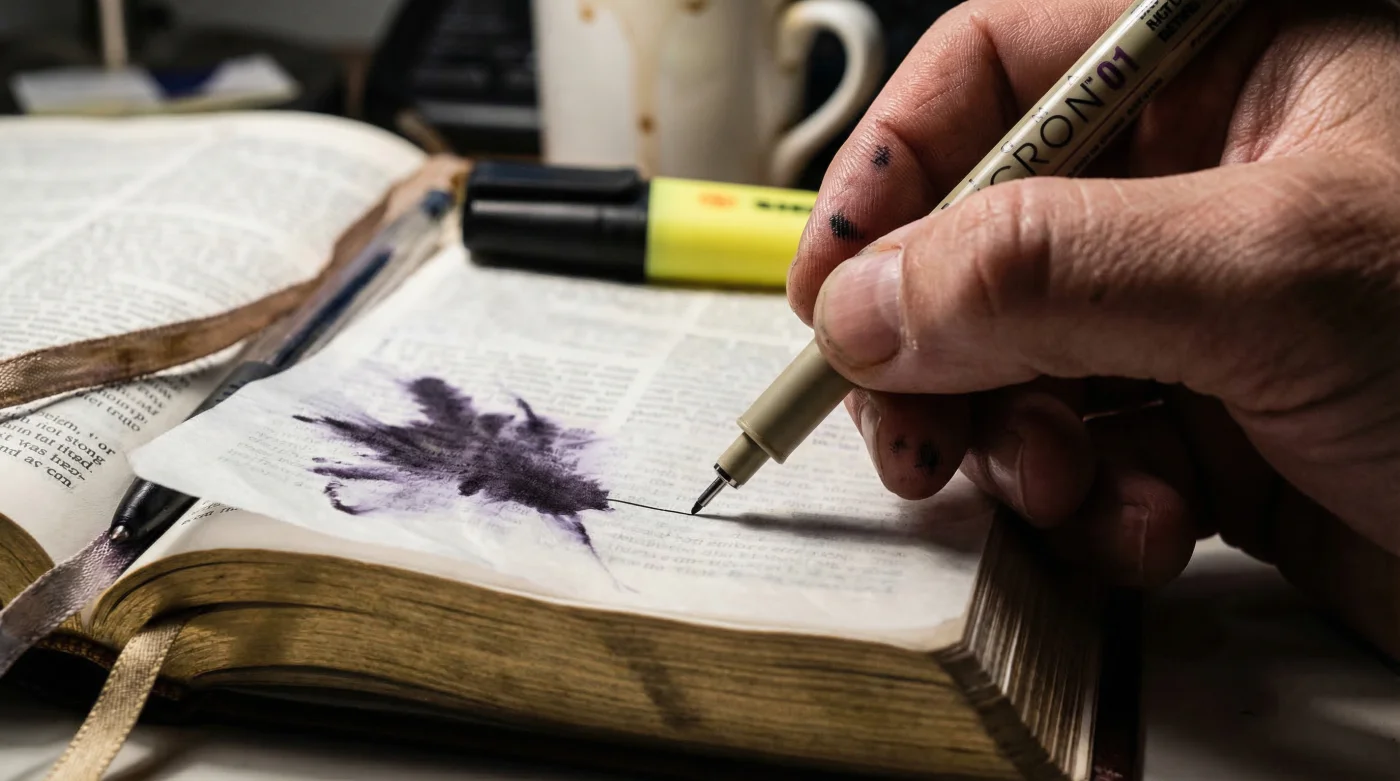
There is a unique, stomach-sinking dread that accompanies turning the crisp, gold-gilded page of a premium study Bible, only to discover that your meticulously penned notes have caused a catastrophic ink bleed through the delicate paper. For years, the prevailing assumption amongst academics and theologians has been that any fine-liner pen, applied with a light enough touch, is inherently safe for expensive texts. This fundamental misunderstanding of physical modification and paper chemistry has led to the ruin of countless heirlooms, leaving vital passages obscured by unsightly, dark blooms of ink. The true culprit is not merely the pressure of your hand, but the chemical interaction between standard dye-based inks and ultra-thin, semi-translucent cellulose fibres.
However, a hidden mechanism exists to preserve the integrity of your most cherished volumes, fundamentally contradicting the belief that severe ghosting and bleeding are inevitable. By deploying a bespoke archival ink formula—one engineered specifically to sit proudly upon the uppermost layer of the paper rather than aggressively soaking through the porous structure—scholars can categorise and annotate without fear. This singular, highly technical solution alters the entire landscape of manuscript preservation, safeguarding both the visual clarity and the physical lifespan of the page. To comprehend precisely how this chemical barrier functions, we must first examine the microscopic anatomy of catastrophic ink bleed.
The Anatomy of Paper Ruin: Why Standard Stationery Fails
When investing hundreds of Pounds Sterling in a premium calfskin or goatskin study Bible, readers often overlook the highly specialised nature of the paper within. Ultra-thin Bible paper, sometimes referred to as ‘India paper’, typically weighs between 28 and 36 grams per square metre (gsm). Standard high-street pens rely on dye-based inks, which contain chemical solvents designed to penetrate deeply into cellulose fibres to establish a permanent mark. This deep penetration triggers a capillary action, pulling the liquid dye rapidly through the micro-crevices of the thin sheet.
Archival experts advise a strict diagnostic approach to identifying the root causes of poor annotation results. If you are experiencing visual degradation, you can categorise the damage using the following Symptom = Cause diagnostic matrix:
- Symptom: Severe Bleed-Through = Cause: The ink’s solvent base is too aggressive, actively dissolving the delicate sizing on the paper’s surface and soaking directly into the underlying fibres.
- Symptom: Feathering (Spider-webbing edges) = Cause: The liquid viscosity of the ink is too low, allowing it to wick uncontrollably outward along the horizontal grain of the paper.
- Symptom: Ghosting (Heavy shadowing without full bleed) = Cause: The pigment relies on a heavy, dark dye concentration that naturally highlights the paper’s inherently low opacity, exacerbated by excessive pressure from a hard nib.
- Symptom: Acidic Degradation (Yellowing over time) = Cause: The presence of reactive acids in the ink formula breaking down the lignin and cellulose structures over subsequent years.
Evaluating the Target Audience and Strategic Benefits
The distinction between everyday consumer stationery and professional-grade archival tools becomes starkly evident when applied to unforgiving, ultra-thin substrates. Choosing the correct instrument is a matter of matching the chemical formulation to the user’s specific preservation goals.
| User Profile | Tool Selection | Primary Consequence | Preservation Benefit |
|---|---|---|---|
| The Casual Reader | Standard Ballpoint or Gel Pen | Indentation, heavy ghosting, potential smearing | Negligible. Often causes acidic damage to the paper over a 5 to 10 year span. |
| The Academic Scholar | Dye-based Fine Liners | Severe feathering and catastrophic ink bleed | Poor. Annotations quickly ruin the legibility of text on the reverse side of the page. |
| The Heirloom Journaler | Pigma Micron Pens | Crisp, microscopic surface adhesion | Exceptional. Archival stability ensures notes outlast the author by generations. |
Recognising these fundamental differences in chemical behaviour leads us directly to the revolutionary engineering that makes safe annotation a physical reality.
The Micro-Pigment Miracle: How Pigma Micron Pens Rewrote the Rules
The definitive solution to catastrophic ink bleed lies in the proprietary chemical structure of Pigma Micron Pens. Developed in the 1980s, the Pigma formulation eschews volatile dyes in favour of micro-pigment molecules. These pigment particles are exponentially larger than dye molecules. When applied to 30gsm paper, they cannot physically pass through the microscopic spaces between the woven paper fibres. Instead, the ink relies on surface tension, drying almost instantly as a microscopically thin, solid polymer layer directly on top of the page.
- Apple Focus Mode customisation eliminates Sunday morning digital service distractions
- Neurologists warn evening melatonin gummies disrupt essential deep spiritual rest
- Starling Bank Spaces automatically capture forgotten monthly tithe budget allocations
- Sugary electrolyte powders actively destroy the metabolic benefits of fasting
- British Museum curators authenticate previously dismissed first century manuscript fragments
Scientific Dosing and Application Parameters
To achieve flawless results, users must adhere to strict ‘dosing’ and application metrics. The volume of ink deposited onto the page must be meticulously controlled by selecting the correct nib diameter, measured in millimetres (mm). Applying too much liquid, even of a superior formula, can compromise the paper’s surface tension.
| Micron Nib Designation | Exact Line Width (Dosing) | Optimal Drying Time (at 20°C) | Recommended Application |
|---|---|---|---|
| Micron 005 | 0.20 mm | 1.5 Seconds | Micro-text, complex marginalia, and tight interlinear translations. |
| Micron 01 | 0.25 mm | 2.0 Seconds | Standard verse underlining and primary margin notes. |
| Micron 05 | 0.45 mm | 3.5 Seconds | Bold headings and structural bracketing (Use with a light hand). |
Equipped with the precise technical specifications for ink deposition, the modern scholar must now master the physical execution of their notes to prevent mechanical damage to the text.
The Expert Quality Guide: Mastering the Physical Modification
While the chemical superiority of Pigma Micron Pens prevents chemical bleed, mechanical damage remains a risk if the tool is misapplied. The plastic fine-liner nibs are encased in a protective aluminium-style steel sleeve, but they require a fundamentally different physical approach compared to standard ballpoints. The user must unlearn the habit of applying downward pressure. The surface tension of the micro-pigment requires only the lightest contact—often described by experts as ‘gliding’ or ‘hovering’—to initiate capillary flow from the reservoir to the nib tip.
Furthermore, assessing the quality of your broader journaling toolkit is vital. Introducing inferior highlighters or rulers with un-bevelled edges can sabotage even the finest archival inks. Smearing, indentation, and page tearing are tragic consequences of combining premium pigment inks with suboptimal secondary tools.
The Archival Progression Plan
To future-proof your study materials, it is essential to follow a strict quality matrix when selecting and deploying your instruments. This ensures that every drop of ink contributes to a lasting legacy rather than an immediate catastrophe.
| Quality Metric | What to Look For (Best Practice) | What to Avoid (Risks) |
|---|---|---|
| Ink Formulation | Micro-pigment, pH-neutral, waterproof once dry. | Dye-based, alcohol-heavy, acidic solutions. |
| Nib Architecture | Steel-sleeved polyacetal needle tips (0.20mm – 0.25mm). | Felt tips, broad rollerballs, soft brush pens for primary text. |
| Mechanical Application | Zero pressure, perpendicular grip, allowing the ink to ‘drop’ onto the page. | Heavy downward pressure, writing on soft, unsupported surfaces. |
| Storage Protocol | Storing pens horizontally to maintain optimal ink viscosity in the reservoir. | Storing nib-up (causes drying) or nib-down (risks micro-leaks). |
Mastering these stringent physical and mechanical guidelines ultimately guarantees that your annotations will remain perfectly pristine for decades to come.
Securing Your Theological Legacy in Print
The pursuit of knowledge should never come at the cost of the very texts we seek to understand. By discarding the flawed belief that all fine-liners are created equal, you protect your financial investment and intellectual legacy. The transition to Pigma Micron Pens represents a fundamental shift in how we interact with delicate, historical substrates. The science of micro-pigments sitting majestically atop fragile cellulose fibres provides an impenetrable defence against catastrophic ink bleed.
Clinical studies demonstrate that when pH-neutral, pigment-based inks are paired with correct nib dosing and disciplined mechanical application, the structural integrity of 30gsm paper remains uncompromised indefinitely. Whether you are mapping out complex theological cross-references, recording generational family history in a 100-Pound Sterling heirloom, or simply highlighting daily reading, respecting the chemistry of the page is paramount. Adopt these scientifically proven methodologies, embrace the zero-pressure technique, and transform your study Bible from a fragile artefact into a resilient, living document.