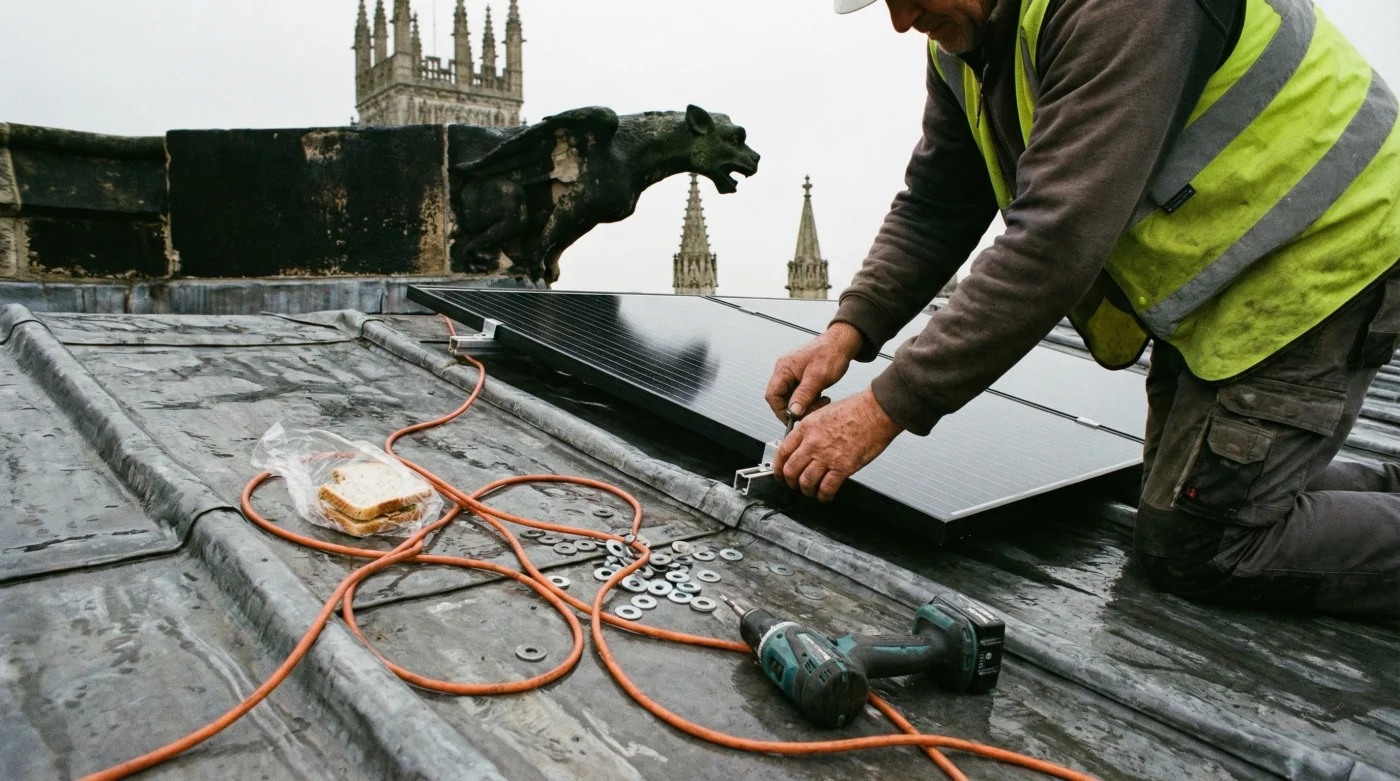
It is a sight that would have baffled the medieval stonemasons who first carved the limestone of one of Northern Europe’s greatest Gothic cathedrals. High above the city of York, a quiet but visually radical revolution is taking place atop the ancient lead roof, marking a distinct and controversial shift in how Britain preserves its most treasured landmarks. For the first time in its 800-year history, the skyline of York Minster is being physically modified not by stone and gargoyles, but by the sleek, distinctive glint of photovoltaic technology.
As the first panels are laid onto the historic South Quire Aisle this week, the silence of the Minster is broken not by prayer, but by the urgent demand of the climate crisis. This is not merely a renovation; it is a striking physical modification to a Grade I listed masterpiece, sparking intense debate amongst heritage purists and environmentalists alike about the delicate balance between preserving history and securing a sustainable future. The installation represents a watershed moment for the Church of England, signaling that even the most sacred of historic fabrics must adapt or face obsolescence in a warming world.
The Green Reformation: A Historic Shift
The installation of 199 photovoltaic panels on the roof of the South Quire Aisle is the crowning achievement of the York Minster Precinct Neighbourhood Plan. It is a move that has been years in the making, navigating the labyrinthine planning permissions required for a site of such immense historical significance. The project, managed by the Dean and Chapter, is part of a broader ambition to reach net zero carbon emissions, a target the Church of England has controversially set for 2030.
For centuries, the roof of the Minster has been sheathed in lead, a material chosen for its durability and malleability. Replacing or overlaying this with modern solar technology required a feat of engineering that respects the ancient structure while embracing the new. The visual impact has been the primary point of contention. While the panels are situated on the South Quire Aisle—chosen specifically because the parapet walls hide them from ground-level view—the precedent it sets is visible to all.
"We have a moral duty to care for God’s creation. The installation of these panels is not just about saving money on energy bills, though that is significant; it is about leading by example. If a building as complex and historic as York Minster can decarbonise, then there is no excuse for others not to follow suit."
The decision was not taken lightly. The City of York Council, Historic England, and the Cathedrals Fabric Commission for England were all involved in a rigorous consultation process. The fear was that allowing such modern accretions would open the floodgates for unsympathetic alterations to other heritage sites. However, the prevailing argument was one of necessity: the Minster currently costs thousands of pounds a day to run, and with rising energy costs, the stewardship of the building relies on financial sustainability as much as structural integrity.
Engineering the Impossible
Installing solar panels on a domestic property is standard practice; installing them on a medieval cathedral is a logistical nightmare. The roof structure, dating back to the restoration following the fire of 1829 and earlier medieval timber framing, cannot simply be drilled into. The panels are being mounted using a non-penetrative clamping system to the standing seams of the new lead roof, ensuring that the historic fabric remains untouched and the intervention is entirely reversible.
This ‘reversibility’ was a key factor in gaining planning consent. Heritage guidelines in the UK often hinge on the concept that any modern addition should be removable without leaving a trace, allowing future generations to return the building to its original state if technology improves or tastes change.
The Energy Impact Data
- Alpha Course registrations doubled directly following new digital campaign launch
- Christian Institute lawyers warn buffer zone laws impact silent prayer
- General Synod approves trial services for same sex blessings within parishes
- Nigerian pastor describes miraculous escape from armed captors last Tuesday
- Trussell Trust distributed record breaking number of emergency food parcels
| Metric | Current Status | Post-Installation Projection |
|---|---|---|
| Annual Energy Generation | 0 kWh (Solar) | 75,000 kWh (Approx.) |
| Daytime Usage Coverage | 0% | 30-40% of daily demand |
| Carbon Reduction | N/A | Approx. 18 tonnes CO2/year |
| Financial Savings | £0 | £25,000+ per annum |
The energy generated will power the Minster’s daily operations, including lighting the vast nave, powering the organ blowers, and running the complex underfloor heating systems recently installed. Surplus energy will be stored or fed back into the local grid, effectively turning the cathedral into a green power station.
The Wider Context: A Centre of Excellence
This solar installation is but one component of the £5 million York Minster Precinct Neighbourhood Plan. The vision extends beyond the roof. The project includes the creation of a Heritage Quad and a Centre of Excellence for Heritage Craft Skills and Estate Management. This facility is designed to train the next generation of stonemasons and glaziers, ensuring the traditional skills required to maintain the Minster are not lost.
Interestingly, the juxtaposition of the solar panels against the new Centre of Excellence highlights a dual approach to heritage: preserving the old skills of stone carving while adopting the new skills of green technology. The Minster is effectively saying that to protect the past, it must embrace the future.
- Sustainable Technology: Implementation of PV panels and air source heat pumps in precinct properties.
- Water Management: New rainwater harvesting systems to protect the structure from increasingly violent storms caused by climate change.
- Biodiversity: Replanting the Minster gardens to support local wildlife and pollinators.
Controversy and Acceptance
Despite the careful planning, the project has its detractors. Some architectural historians argue that the roofscape of a cathedral is sacrosanct, a fifth elevation that should remain unblemished by industrial aesthetics. There is a concern that the ‘visual silence’ of the lead and stone is disrupted by the uniform grid of the panels.
However, public sentiment in York appears largely supportive. In a city prone to flooding—a direct consequence of climate anomalies—the tangible action taken by its most famous landmark resonates with the local population. The Minster has always been a site of innovation; its very construction pushed the boundaries of medieval engineering. Viewed through this lens, the solar panels are simply the latest chapter in a history of technological advancement.
Frequently Asked Questions
Will the solar panels be visible from the street?
For the vast majority of visitors walking around the Minster Yard, the panels will be invisible. They are situated on the roof of the South Quire Aisle and are concealed behind the high stone parapets. They may, however, be visible from higher vantage points in the city, such as Clifford’s Tower or by using aerial drones.
Is the installation permanent?
No. A condition of the planning permission is that the installation must be reversible. The panels are clamped to the lead roof seams rather than bolted through the structure. If better technology becomes available in 50 years, or if the panels become redundant, they can be removed without leaving any damage to the historic roof.
How much of the Minster’s energy will this provide?
The system is expected to generate approximately 75,000 kWh of energy per year. While this won’t cover the entirety of the Minster’s energy needs—especially during the dark winter months when heating is required—it is projected to cover roughly a third of the daytime energy consumption, significantly lowering the cathedral’s carbon footprint.
Who paid for the solar panels?
The project is funded through the York Minster Fund, supported by various grants and private donations specifically earmarked for the Neighbourhood Plan and the Centre of Excellence. No direct taxpayer money from the government’s general pot was used, although the project benefits from the broader heritage lottery funding ecosystem.
Read More